Friday, November 19, 2021

The 2021 apple pest season according to the RIMpro Cloud Service

Directly from their website "RIMpro Cloud Service is an interactive Decision Support System (DSS) for pest and disease management in fruit and wine grape production. For many growers and consultants RIMpro is their essential tool for effective crop protection." We have been using RIMpro for some years now, and although not for everyone - NEWA being a good alternative - it is the most sophisticated and granular DSS out there. Visual presentation of model output  - such as the the flagship RIMpro Venturia (apple scab) model - is a particularly good and useful feature of RIMpro. To that end, I present mostly -- with a little explanation - the graphical RIMpro model output for most of the important apple pest model outputs of RIMpro, including Venturia (apple scab) for the 2021 growing season at the UMass Orchard in Belchertown, MA...

Apple scab model output based on weather station. Only when the red line (infection value) exceeds 100 is the scab risk high in an otherwise "clean" orchard. Thus, five apple scab infection periods that would need fungicide coverage, probably a combination of protectant and kick-back fungicides. I'd be looking at six sprays maybe?

Apple scab model output based on virtual (meteoblue.com) weather data. Whoa, big difference from onsite weather station. Here, nine RIM values exceed 100 (Medium infection risk) which would trigger at least nine fungicide sprays? The virtual weather data appears to over-estimate when it rains (or not).

Apple powdery mildew. Not clear on how to interpret, but it looks “bad!” Yes, powdery mildew was an issue this year on susceptible varieties like Cortland and Honeycrisp. Really. Pretty. Bad.


Fire blight. According to this RIMpro output there was one actual fire blight infection on May 18th wherein first visual symptoms should appear about May 25-26. A streptomycin spray then should have resulted in no fire blight. This is confirmed at the UMass Orchard. Plenty of fire blight around elsewhere though, interesting…


Moving on to an early insect, rosy apple aphid, the little buggers. The way I interpret this, nymphs and adults are in abundance and not yet curled up in the foliage during a tight spray window of approximately the last week in April into the first week of May. Two weeks. Indeed, this was overlooked and RAA was a real problem in certain orchard hot spots. Bad, trust me, resulted in many stunted/deformed apples.

Another early insect, apple sawfly. RIMpro shows May 11 as a recommended insecticide application date. This was during the early petal fall period, which can be problematic. Fortunately, sawfly seems to be a significant problem only in loosely managed orchards, in most it is not an economic issues. Of course you can see there is also activity pre-bloom, so a pre-bloom insecticide is also an option, although most would say not a good option.

Codling moth. Pretty straight forward if targeting hatching eggs and L1 larvae with an insecticide, for first generation about June 20, and for second generation (if necessary) in mid-august.

Codling moth using virtual weather data (even though I said I was not going to bring it up again). But, as the codling moth model only uses degree days to calculate CM life cycle, it is much better than when using wetting information in a disease model. Here, the CM insecticide spray windows largely agree with spraying dates using the on-site weather station.

Ah, some horticulture, apple thinning, only available when using the meteoblue weather forecast (virtual data). Pretty busy chart, eh? Let me just point out that app. May 23 and then again on May 27 there were  modest carbohydrate deficits, which would have been good chemical thinner application windows if you expected those chemical thinners to work. The growing pollen tube growth/squiggly blue lines also presumably help you time caustic bloom thinner application, but who does that anyways?

Sooty blotch/flyspeck. Who cares? All I know, is that in addition to preventing rots — that is another story this year — you need to be applying fungicide every 10-14 days (assuming it rains an inch or two during that time, no problem with that this year) beginning late June right up to harvest (following PHI’s of course). Watch late varieties in particular with moderate-severe infection events ins September-early October.

Marssonina leaf blotch. An increasingly vexing problem, seen plenty of it at the UMass Orchard beginning in mid-September, Golden Delicious, Mutsu, Fuji, Honeycrisp, Pazazz, and Topaz. Among others. Macs seem pretty immune to it. A fungal disease similar to scab, however, requires season-long control. Getting lax with late season fungicides can cause early defoliation, not sure how bit a problem that is? Can cause fruit spotting, but have not really seen that yet, stay tuned? RIMpro output suggests many infections, indeed that was the case I think…


Yes, we got apple scab in 2021 on unsprayed trees

Fresh apple powdery mildew!

Oh yes, there was fireblight, none at the UMass Orchard, but sporadically/widespread elsewhere!

Rosy apple aphid (RAA) nymph on apple bud in early April

Deformed apples in early July a result of RAA infestation

Marssonina leaf blotch on Evercrisp in late September


By late October (harvest time) these Evercrisp were completely defoliated a result of Marssonina leaf blotch!

Wednesday, September 1, 2021

Double-notching whip apple trees at bud break effective at promoting branching


Nursery apple trees that arrive as unbranched, so-called “whips” are a perpetual problem. In the old days, when growing a central-leader tree, those whips were simply headed (cut) at waist height and then a lower tier of scaffold branches would result from buds breaking and shoots growing (feathers) vigorously just below the heading cut. Then some of those would have to be “stripped” off so a proper leader could form (http://fruitadvisor.info/tfruit/clements/articles/youngtreetraining.htm).

But if a tall-spindle system is being planted, that heading cut is a big no-no, you don’t want strong vigorous shoots growing that form permanent scaffold branches. Unless the nursery tree comes already feathered, it’s nice to get numerous smaller branches “breaking” along the length of the leader starting at approximately knee height and moving up the leader. What typically happens on whips, however, is only the top buds break going a foot down or so from the top of the leader. In addition to ending up with a top-heavy tree, those shoots will flex their apical dominance and further prevent lower buds from breaking. So, intervention is desired on newly planted whip apple trees to get the uniform branching up and down (to knee height) the tree and create the desired tall-spindle form early and going forward.

Several techniques can be used to induce this kind of branching. A common recommendation is to spray the leader with 6-BenzylAdenine (6-BA) at bud break. 6-BA formulations include Promalin or Maxel (Valent) and Exilis or Perlan (Fine Americas). Over the years, I have found this to not be particularly successful at inducing branching (http://umassfruitnotes.com/v75n3/a3.pdf). Dormant buds along the leader can also be painted with a high concentration of 6-BA in latex paint but this must be done before bud break. It is largely successful but can stunt the growth of the resulting shoots (http://umassfruitnotes.com/v79n3/a2.pdf; http://umassfruitnotes.com/v80n1/a2.pdf; http://umassfruitnotes.com/v85n1/a6.pdf). Notching of the leader just above the bud where a branch break is desired can be effective, however, it is time consuming when using a hack-saw blade as has been often recommended. Recently, I’ve become aware of using a double-edged, anvil-style hand pruner making two opposite side “notches” just above buds in the region where branching is desired (Stefano Musacchi, WSU, personal communication). I have previously tried this here and there and my observation was that it does indeed appear to be quite effective. So, in 2021 I decided to do a mini-experiment to demonstrate this method of inducing branching on whip nursery apple trees.

Methodology was quite simple, I selected 30 just-planted whip apple trees at the UMass Orchard in Belchertown, MA. In a random manner, ten of the trees were NOTCHED using a double-edge hand pruner (STA-FOR Double Cutting Pruner, https://www.oescoinc.com/hand-tools/hand-pruners/double-cutting-pruner.html) just above each bud in the region where branching was desired, i.e. from approximately knee height then upwards about 18 to 24 inches. Typically, eight buds (plus or minus) were thus double-notched. This was done just as the buds in the top of the trees were breaking, but the dormant buds that were notched showed little or no growth (yet). 6-BA in the form of Promalin per the label rate (400 ppm) and directions for promoting branching at bud break was also applied to a similar region of the leader on ten other trees, and ten trees were left alone (the UnTreated Control, UTC).

In mid-June, the number of branch breaks (greater than 2.5 inches in length) on each tree in the region the branching treatments were applied were counted, and the results speak for themself. NOTCHED trees averaged 8.5 “breaks” per tree that are becoming feathers or branches. Nearly every notched bud broke and grew into a feather. 6-BA way underperformed compared to notching, with only 1.9 breaks per tree, and the UTC only resulted in an average of 0.8 branches per tree. (If you insist, a statistical analysis was done on the data, and the difference in branching was significant, and the NOTCHED treatment resulted in significantly more branching than the 6-BA and UTC treatments, which did not significantly differ from each other.)

Clearly notching using this double-edged anvil-style pruner is effective, and making the notches using the pruner is reasonably quick. Care must be taken, however, to not cut all the way through the tree nor to girdle the tree. (Someone suggested angling the pruner a bit to lessen the risk of girdling.) For several hundred newly planted trees that are whips it sure beats getting out the 6-BA filled backpack sprayer or the paint mixed up with 6-BA asNOTCHING in this manner is very effective at making branches. You do of course need to have a viable bud where the notch is made, and it is not alone effective at breaking branches on older “blind” wood without further intervention (http://umassfruitnotes.com/v82n3/a2.pdf). Furthermore, 1st-leaf trees should be planted early, fertilized, and irrigated to get the most out of your notching effort.

Here is a YouTube video about this mini-experiment: https://youtu.be/x2EqTUTBhFc

NOTCHING just above a dormant bud using a double-blade anvil style pruner

NOTCHING resulted in 8.5 feathered branch breaks per tree

6-BA application resulted in an average of only 1.9 feathered branch breaks per tree

UTC (no intervention) resulted in average of just 0.8 feathered branch breaks per tree


Saturday, June 26, 2021

Fire blight's ugly side...

Blossom blight on newly planted NY-1 apple tree
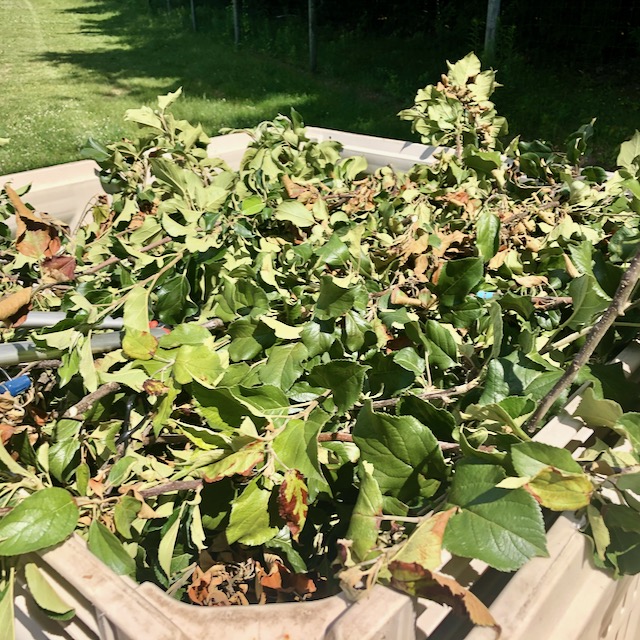
Does it have a pretty side? No, of course not. But this past week I saw a particularly ugly side of fire blight.

First up, this year's planting of NY-1 (sold as SnapDragon®) apples. Serious fire blight taking out significant portions of the leader, maybe up to 50% of trees planted. Sorry sight. Conversation with grower:

Grower: "Did it come in from the nursery?"

Me: "Nursery will deny it and in reality you have a mature apple block next door with a history of fire blight and these affected trees had a lot of bloom, right? Did you remove the bloom or spray streptomycin during bloom?"

Grower: "No on removing the bloom, but I did spray strep once, and there was no rain when they were in bloom."

Me: "Yea but I checked NEWA and indeed the fire blight risk was high to extreme and it does not take much wetting, for example airblast spraying or heavy dew, to spread the blight around and cause infection."

Grower "Oh, now what can I expect?"

Me: "Well you are cutting the fire blight out during dry weather to the best of your ability, it is a shame given many trees have significant part of the leader with blight, and some trees will have to be removed completely. And you will continue to see more blight after you think you have it all cut out. You should probably also spray copper as often as feasible, that will help reduce the spread. And next year be on top of bloom with strep sprays when the fire blight risk is high. Hopefully infection will subside now which is usually what happens after the initial outbreak, but it won't go away unfortunately."

Grower: "But I still think it came in from the nursery :-)"

OK, questions lingering in my mind after departing the orchard. Is SnapDragon® particularly susceptible to fire blight? I know for a fact it's sister NY-2 (sold as RubyFrost® apples) is very susceptible. And a couple other adjacent just-planted varieties (MAIA apples) had some, but not nearly as much, fire blight. And, I know there are other recommendations out there to help prevent further spread in young trees, what are those? Double Nickel and Cueva? Actigard and Prohex-Cal (Apogee/Kudos)? But of course I did not remember the details.

Second, another new planting, this time MAIA-1 (sold as Evercrisp® apples), orchard crew in the middle of once again cutting it out. Enough to be time consuming, will never get it all, and in some cases the whole leader blighted. Ugh. Was not easy to elicit whether strep sprays had been applied, maybe just once? Now I was getting mad after seeing this twice in one week, and it seems to me this could have been prevented? Or maybe not given the fact this new apple planting was adjacent to a block of cider apples! Now there is double trouble if I ever saw it! A history of fire blight in this cider block, of course. Found some blight over there right now, Dabinett, Stokes Red had more than most of the others. It's just not a good idea planting a new apple orchard next to a cider apple block! (Is it a good idea to plant cider apples period? I am beginning to wonder...)

Shoot blight (likely originated from blossom) of 1st-leaf MAIA-1 apple tree

Bin full (literally) of fire blight prunings

Fire blight in cider apple (Dabinett or Stokes Red)

OK. What could have and should be done to prevent or reduce fire blight infection on these 1st-leaf trees:

  • Manual removal of bloom. I know, it is time consuming but probably the number one thing you can do to prevent blossome blight infection. Usually requires several trips, every other day or so through the orchard to get all the bloom. I just clip the flower petals off at the pedicels with scissors or similar.
  • Lacking bloom removal, frequent strep and copper sprays, as recommended by consultant Win Cowgill. Copper beginning at bud break, your choice of product at moderate rate. Streptomycin beginning when first blooms open and continuing every 2-3 days as bloom opens. Need several (many?) strep sprays to keep up with open bloom. Until it is done. Strep probably not necessary if it is absolutely dry and there is no risk of fire blight infection predicted by the models, but that is rare. I know there are peaches to prune and vegetables to plant but you need to find time to do this! And think about coverage, there is not much tree there, turn off the fan, go slow, make sure you are getting good coverage and not blowing your spray all over the place!
  • If you are not successful with above, yes, cut out the fire blight. In dry weather. Does not hurt to sterilize pruners between cuts unless it signficantly hinders speed of fire blight removal. Goal should be to get it out of there ASAP. Remove prunings well away from orchard if possible, otherwise put in middle, let dry out for a few days, and mow. Always during dry weather.
  • After pruning, it looks like the best option to prevent further shoot blight are regular applications (every 1-2 weeks?) of Double Nickel (a biofungicide) and Cueva (a low rate copper). There are other "biologicals" out there, but the Double Nickel/Cueva option seems to have the most mentions and has proven to be the most effective at preventing shoot blight. Kari Peter at PSU has a good review of these options here. (I wonder about Oxidate? Couldn't hurt.) And oh yes, a strep application if a trauma event -- rain with high wind and/or hail -- occurs.

Finally, be on top if it next year. George Sundin at MSU recommends Actigard with Prohex-Cal on young trees (2nd and 3rd-leaf) at high risk for fire blight. And strep during bloom when the fire blight warning flag gets hoisted is still your best friend.


Friday, May 7, 2021

Fire blight prediction models — words and colors (and numbers?) matter

This week apples have been in bloom in Massachusetts. Along comes the risk of fire blight blossom blight. Warm temperatures and moisture are known to be the trigger for blossom infection by fire blight. It’s been relatively cool — 60’s to lower 70’s — so the apparent risk of infection has been perceived as low. In addition, we have fire blight models on NEWA (Network for Environment and Weather Applications). And they — both Cougar Blight and the EIP (Epiphytic Infection Potential based on the MaryblytTM model) were showing generally low risk for blossom infection by fire blight. Nice, breathe easy, right?

But wait, there is always a catch when it comes to dealing with fire blight. A grower, who has a history of fire blight in their orchard, called me in the afternoon and said something to this effect, “Jeez Jon, this morning NEWA was showing low risk of fire blight infection but now one of them is green (Cougar Blight) and the other (EIP, Maryblyt) is showing HIGH, ORANGE risk of infection. What gives? Do I need to spray streptomycin? Arghhh, I had just put a cover spray on for scab this morning but did not include strep and I really don’t want to have to go out and spray the whole orchard again to prevent fire blight, what should I do?”

Great. Begs many questions. For one, I told the grower I am never going to tell him definitively NOT to spray strep for fire blight! But seriously, the day turned out warmer (low 70’s) than predicted (mid 60’s) so the model output changed. But why the perceived difference (by the grower) in model outputs, Cougar Blight being GREEN (low risk of infection?) while the EIP was ORANGE signifying much greater risk of infection? I was unable to give them a clear answer, so I had to do a little digging to refresh my memory on how the models differ in estimating risk of infection. I want to say here, however, the user-interface (on NEWA) is not the best and I hope my discourse might result in some clarification of the fire blight model outputs on NEWA going forward? Kerik?

OK, all a grower needs to know about the two fire blight models on NEWA, Cougar Blight and EIP.

Cougar Blight simply accumulates degree hours as heat units beginning at bloom. Then, models the fire blight infection risk level based solely on these accumulated heat units/degree hours. Note that it does NOT use wetting or anything else in determining risk, you have to assess the level of wetting's contribution to fire blight infection, be it rain, dew, spray event, etc. But if Cougar Blight says the risk is HIGH or particularly EXTREME you better be applying some streptomycin to open bloom if wetting occurs. Note that the infection risk level also changes based on the amount of fire blight recent history in the neighborhood. Generally I leave it as fire blight occured in the neighborhood last year to keep it middle of the road unless I know fire blight is currently active. Very simple, but realize the Cougar Blight model can say HIGH or EXTREME but if there is no wetting event, there will be no infection. Here is the latest on Cougar Blight from WSU, but realize they talk about wetting event in their DAS which is not included in the NEWA Cougar Blight model. 

EIP as I said is straight out of the MaryBlyt model. Which is way more complicated than Cougar Blight! (Which makes it better? Maybe?) I will try to boil it down to as simple as possible. For a blossom blight infection to actually occur, regardless of whether EIP/Maryblyt shows up YELLOW or ORANGE, four condidions must be met:

  1. open bloom (D'oh! as Bart would say)
  2. degree hours/heat units accumulation threshold
  3. average (daily, 24 hours) temperature greater than or equal to 60 degrees F.
  4. AND wetting! one tenth of an inch or more of rain, or could be heavy dew or dilute spray event?

INFECTION will not occur unless all four of these conditsion are met. Just one, two, or three of these conditions might indicate LOW, MODERATE, or HIGH risk of infection, but you would still need the fourth parameter, likely wetting, for INFECTION to actually occur and eventually show up as blossom blight. Below is a Table -- straight out of the 44 page Maryblyt manual, available here -- that pretty much sums it up:


Ok, let's look at the NEWA fire blight model ouptut that triggered this blog post:


The afternoon in question was 5/3, this model output was run after the fact, and actually at the time on 5/3 Cougar Blight was showing a GREEN table cell. You can see why the grower might have been concerned, not understanding the nuances of the models, a GREEN-Low infection risk cell table in Cougar Blight, and an ORANGE-High infection risk in EIP (Maryblyt). Huh? Admittedly, NEWA does, below the Table provide this explanation: 


Somewhat helpful but not overly, especially if you are panicking trying to figure out if I should apply a strep spray or "Oh crap, how come I did not include strep in that scab spray I just put on this morning???" Really, I told the grower it was in fact borderline and forecast cooler temperatures might reduce the risk of infection significantly. They still went out and sprayed streptomycin on younger, more susceptible blocks, or maybe it's been rumored they sprayed the whole orchard! Was there actually an INFECTION? Probably not, no, it appears not all four conditions were met for an INFECTION to occur. Bloom? Check. Degree hours? Check, barely, briefly, but then went down the next day 5/4. Wetting. Check, but not until next day 5/4. Average Temperature? Check, but only for 5/3 and barely. NO INFECTION! No need to spray strep! If you have faith and believe the models are right?

My thought is growers really need to know that all four conditions -- bloom, degree hour accumulation, average temperature, and wetting need to be met for an INFECTION to actually occur. This again in the Maryblyt manual is helpful: "A blossom [strep] spray is recommended when the risk is HIGH and when an infection is predicted for the next day."

Oh, and then there is RIMpro...

Whew, not sure I really cleared anything up or simplified it or not? Note to self, stick with horticulture, want to talk about thinning sprays now??? :-)

Sunday, March 28, 2021

Tree Row Volume - it doesn't matter.


A recent New England Tree Fruit Extension Seminar focused on Tree Row Volume (TRV): What it is, why it matters, and how to use it. (You can watch the recording here when it becomes available.) After a brief introduction about TRV by the host, a guest speaker -- Jason Deveau, of sprayers101.com fame -- cut to the chase about what (IMHO too) is really important, that is spray COVERAGE. Because, modern pesticide labels make no mention of TRV or rate per 100 gallons, a rate that was based on dilute spray coverage using TRV. Forget TRV, just worry about getting good coverage with an adequate amount of water. Then apply the amount of pesticide per acre as noted on the label in that amount of water that is getting you good coverage. Bingo.

I am not going to talk about how to get good airblast sprayer coverage here. For that you need to get your copy of sprayers101.com/airblast101/. But let's look at a scenario. Let's say you have a tall-spindle apple orchard. Using TRV, it calculates out to about using 100 to 125 gallons of water per acre that would give you really good coverage. Fine if you are spraying oil. But when not, most growers I know spray tall-spindle using 50 to 60 gallons per acre and get quite adequate coverage. Adequate is fine because you can only fill up the sprayer so many times, right? There are other things to do!

OK now, let's look at a very modern pesticide label, that of Valent's Excalia. For apple scab, it says use 3 to 4 fluid ounces of Excalia per acre in a minimum of 100 gallons of water per acre. (Interesting on the minimum 100 gallons of water per acre, that is unfortunate, I would ignore it and as long as you are getting good coverage -- the label says "Equip sprayer with nozzles that provide accurate and uniform application" -- you should be fine.) So, if your tall-spindle orchard has a little smaller trees or pest pressure is on the lower side, use 3 ounces of Excalia in that 50 to 60 gallons of water. Alternately, if pest pressure is high and trees are just a little bigger, use 4 ounces. Simple. You got good coverage and are applying the label-correct amount of pesticide per acre. Modify this train of thought accordingly to your tree size/acreage/pesticide label. Point is to get good COVERAGE with the label-recommended amount per acre of pesticide.

One little monkey wrench thrown into this thought process might be when using Plant Growth Regulators (PGR's). Because, their label rate typically DOES NOT use rate per acre, but instead amount per 100 gallons (dilute TRV). (Or even worse, Parts Per Million (PPM). Ugh.) Don't stress though. Let's look at NAA in the brand name PoMaxa. The label says to use 1 to 4 fluid ounces of PoMaxa in 100 gallons (TRV) for apple thinning. So my tall-spindle orchard, to keep it simple, requires 100 gallons per acre TRV. So if I wanted to use a 4 ounce rate (equivalent to 10 PPM) I would need 4 ounces of Pomaxa in 100 gallons of water to cover that acre. But I am using 50 gallons to cover an acre, so I still need to add that 4 ounces in the 50 gallons of water, right! (Which is now technically equivalent to a 20 PPM solution, isnt' it? Why I don't like PPM.) Interestingly again, in the text of the label, it says "A typical rate for a moderate-to-thin apple cultivar in an orchard which requires 100 gallons of water per acre to achieve drip is 2 fl oz of PoMaxa per acre. For an acre requiring 200 gallons to achieve drip, use at least 4 fl oz per acre." Makes perfect sense, doesn't it? So why not just say that on the label and leave it at that! My advice would be for apple thining to say "use 2 to 8 oz. per acre depending on tree size and amount of thinning desired!" That would cover most dwarf and semi-dwarf orchards. And that is what I tell growers! For more on this topic: Spray Mixing Instructions (for PGR's) Considering Tree Row Volume

So, even though my start-out premise was TRV is dead, I came about and with PGR's not so fast! Sorry about that. I still contend, however, focus on getting good COVERAGE. Then for fungicides and pesticides use the label rate per acre, adjust the amount of product based on tree size and pest pressure. But always within the label amount (minimum and maximum) per acre. For PGR's, put on your thinking cap, analyze the situation a bit, and convert the label recommendation, whether it's amount per 100 gallons TRV or PPM, to rate per acre. Small trees, less PGR per acre, large trees, more PGR per acre. Less efficacy -- need for less thinning for example -- less PGR per acre, more efficacy, more PGR per acre. Makes kind of common sense doesn't it?

Still want to calculate TRV?

Fungicide alphabet soup - time to pour it down the drain!


I have a love-hate relationship with tree fruit plant pathologists. LOVE, because diseases -- apple scab, fire blight, brown rot, etc., you get the idea -- are arguaby the most problematic pest management issue pome and stone fruit growers face year in and year out. (And climate change, with more frequent rainfall is not going to make life any easier.) But tree fruit plant pathologists are the experts working on it! HATE though because of all the jargon they espouse when describing fungicide MoA's. There we go, I mean Mode of Actions. And you know what I mean, SDHI's, DMI's, QoI's (Strobies), AP's (what did I miss?) and now they say multi-site and single-site? Give me a break!

Here is my suggestion -- let's just ALWAYS ONLY use FRAC numbers. As in: https://www.frac.info/fungicide-resistance-management/by-frac-mode-of-action-group. If I am correct, most tree fruit fungicides fall into one of six FRAC Groups:

  • M1 - coppers; M2 - sulfur; M3 - mancozebs, Ziram; and M4 - Captan, M7 - dodine/Syllit. These are Multi-site as designated by the "M." Good rotation partner for resistance management. M is good, good, good. M=good.
  • 1 - Topsin, t-methyl. Thus starts the single site fungicides. (Last time we will ever use single- or multi-site. OK guys and gals?) Not so good for resistance management when used time after time after time. Right?
  • 3 - Indar, Rubigan, Vintage, Procure, Cevya. Formerly DMI's. And before that, SI's! Ackkk!!! No more! Banned. 3's from now on!
  • 7 - Aprovia, Fontelis, Sercadis, Excalia. Formerly SDHI's.
  • 9 - Vangard, Scala. Formerly AP's. Formerly.
  • 11 - Flint. Formerly known as a QoI. Banned.

Of course there are the pre-mixes too, common ones include: 7+11 (Pristine, Merivon, Luna Sensation); 3+9 (Inspire Super), (Merivon), and 7+9 (Luna Sensation/Tranquility). Oh, and then there's Syllit (Dodine), label says it's a U12. But according to FRAC it's an M7, multi-site, but the verdict seems to be out on that. Who wants to use that DANGER signal word causes irreversible eye damage $%&# anyways???!!!

So, go ahead and use M's. All the time if you want, but remember, they are largely preventive, i.e. have to be applied before the infection occurs. And then go ahead and use the 1's, 3's, 7's, 9's and 11's. But only in up to two back-to back-applications. Then use another number (or combination of numbers). These fungicides have some kickback (post-infection) activity, ranging from 1 to 4 days (maximum, at best), as well as preventive activity. I like them. 

Ok, there you go. I made a fungicide recommendation while ditching the alphabet soup! I invite the tree fruit pathologists to follow suit! :-)


Wednesday, November 25, 2020

Weather Data Source and Apple Scab DSS Model Output – Does it Make a Difference?

 Jon Clements (UMass Extension) and Daniel Cooley (Stockbridge School of Agriculture)

Weather data source, the location of a station, and DSS each make a difference in numbers of fungicide applications to control primary apple scab. So why the difference? Is the weather data different? Probably. Are the models interpreting the data differently? Probably. So it’s a combination of both? Likely.

INTRODUCTION
In the Northeast it is not possible to produce apples commercially without timely fungicide sprays to control apple scab. Decision Support System (DSS) models based on weather data allow more targeted and potentially better scab control with fewer fungicide applications than a calendar spray schedule during the primary phase of apple scab infection. But does the source of weather data input or the DSS make a difference in predicting infection periods? To answer that question, we compared weather data collected in 2020 from several weather stations and a virtual weather data source at the UMass Orchard in Belchertown, MA.

METHODS
Weather data was collected from four on-site weather stations at the UMass Orchard in Belchertown, MA. Two stations are situated close to one another, and the other two farther apart, as shown in Table 1. Weather stations included two RX3000 and one U30 weather station from Onset Computer Corporation (onsetcomp.com), and one Rainwise (rainwise.com) weather station. All collect temperature, wetness, and precipitation data, requisites to run the primary apple scab infection model on the Network for Environment and Weather Applications (NEWA). The NEWA apple scab model is based on Mills Table infection events with modification. We also looked at one “virtual” weather data service (meteoblue.com) feeding weather data into RIMpro (rimpro.eu), a cloud-based DSS running its own (proprietary) version of the apple scab infection model. RIMpro was also run using data from the Rainwise weather station.

Table 1 - Name (DSS used in this blog post), Station hardware, Lat./Lon., Elevation, and DSS of weather stations or virtual weather data source at the UMass Orchard, Belchertown, MA. (Click on Table to see larger.)

RESULTS
Examples of how and when infection periods for NEWA and RIMpro were determined are shown in in Figures 1. and 2. respectively. Then, all apple scab primary infection periods evaluated by each system is graphically illustrated in Figure 3. Red color-filled table cells with an ‘x’ in them are scab infection periods (by day). Yellow color-filled cells are presumed fungicide spray infection prevention events that are based on a few simple rules: a preventive fungicide spray before every infection event; a post-infection (kickback) spray during longer infection periods and/or during the accelerated phase of ascospore maturity/development; and for RIMpro, following the previous two rules, but only when the RIM infection value exceeded 100 (daily RIM value indicated by the number). From Figure 3., all primary infection periods from green tip to 100% ascospore maturity and final release of spores, and proposed spray events were counted for each Decision Support System and are shown in Table 2.

Figure 1 - Example of how apple scab infection periods are counted in NEWA. (Click on Figure to see larger.)

Figure 2 - Example of how apple scab infection periods are counted in NEWA.


Figure 3 - Apple scab infections (in red) predicted by DSS and suggested spray events (in yellow) for the primary appe scab season beginning 1-Apr iland ending 30-June. (Click on Figure to see larger.)

Table 2 - From Figure 3, total number of Infection Periods and Proposed Sprays during the primary apple scab season by DSS (Name).

DISCUSSION
Primary apple scab infection periods ranged from three infection events for RIMpro up to ten infections for NEWA (Table 2). Spray events followed similarly, ranging from three fungicide sprays to twelve sprays. Thus, the number of infection periods and proposed fungicide sprays vary significantly, from three to ten and three to twelve respectively. There are several sources of variability that could result in such different DSS outputs, including: virtual vs. hardware weather station (including manufacturer), location in the orchard, and different DSS interpretations of the scab model, particularly NEWA vs. RIMpro. Several assumption, particularly when it comes to spray events, have been made too, which could be argued. But these differences are concerning and could result in a grower taking different actions, and experiencing different outcomes, like getting scab, depending on how weather data is collected and what DSS is used. Therefore, there is a need for further field testing using fungicide applications applied according to each Decision Support System.

For further reading:
Clements, J., and D. Cooley. 2013. A Comparison of Two Sources of Environmental Data and Three Model Outputs for Primary Apple Scab in 2012 at the UMass Cold Spring Orchard. Fruit Notes, Volume 78, Spring 2013. http://umassfruitnotes.com/v78n2/a2.pdf

Garofalo, E., A. Tuttle, J. Clements, and D. Cooley. 2016. Discrepancies Between Direct Observations of Apple Scab Ascopore Maturation and Disease Model Forecasts in the 2014 and 2015 Growing Seasons. Fruit Notes, Volume 81, Spring, 2016. http://umassfruitnotes.com/v81n2/a2.pdf

Weather data in, DSS out for apple scab infection period model -- does it make a difference? (YouTube video.) A comparison of four on-site weather stations and one virtual weather service as data sources in 2020 for the apple scab infection period model in two Decision Support Systems at the UMass Orchard in Belchertown, MA. A presentation at the 62nd Annual New England, New York, and Canada Pest Management Conference for Extension, research, and consultants, October 19, 2020 via Zoom. ©2020 Jon Clements and the UMass Fruit Advisor, umassfruit.com. Or play here...