OK, a little something different, not to sound cliche, but "2023 - the year in review." And this kind of sums up how I feel about 2023...Blow me one last kiss!
Month-by-tedious month, with some picts and comments...
January
Was the warmest January on record in Massachusetts, average temperature of 35 F. (max 55, min 32) at the UMass Orchard in Belchertown, MA according to NEWA. Trees have accumulated enough chilling hours to come out of dormancy and are not particularly at maximum winter hardiness either. So wait for it...
These Gala buds looked pretty good on 16-January. No snow to speak of.
Dr. Duane Greene gave the George A. Goodloing Memorial Lecture at the Mid-Atlantic Fruit & Vegetable Conference in Hershey, PA on 31-January.
February
...an arctic cold front brought record cold on 4-February, -13 F. at the UMass Orchard in Belchertown the day after we returned from Hershey. Following highs approaching 50 F. the last week in January. Bye-bye peach (and cherry) crop for 2023.
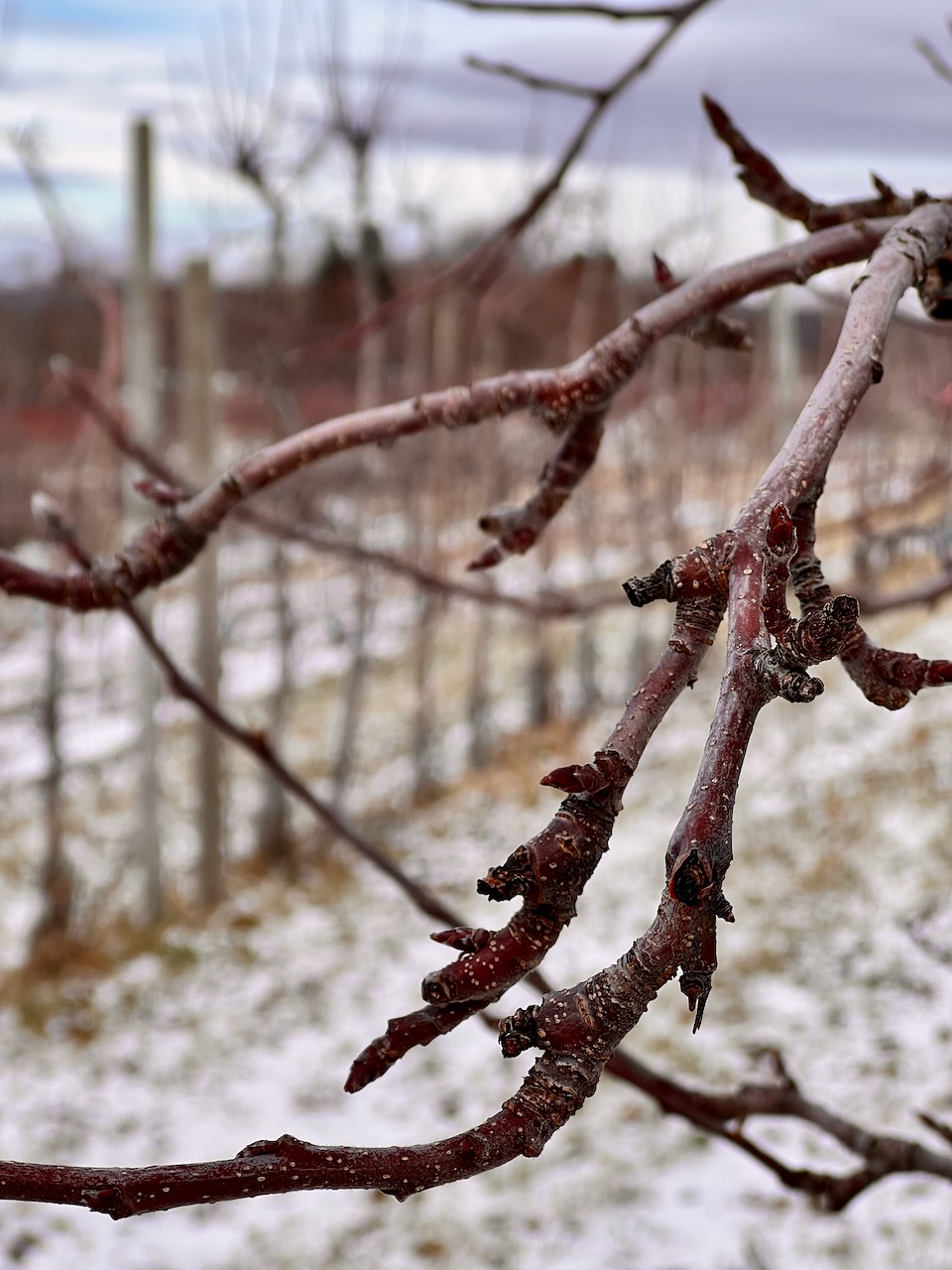
Peach buds hosed on 6-February at the UMass Orchard and across Massachusetts.
What a difference a day makes...
Honored at International Fruit Tree Association Annual Conference on 16-Februaryin Grand Rapids, MI after nine years on the Board of Directors. Along with Jeff Clerveringa and Dale Goldy, us "old guys."
March
Our winters seem to be "back-end" loaded lately, it snowed and was rather cold. Average March temperature was 38 F. It was 35 F. in January and 32 F. in February. All right, it warmed up a bit. Passed the time co-hosting Northeast Plant Growth Regulator meeting and spoke on Precision Apple Cropload Management and Apple Varieties at Maine Pre-season Fruit Meeting in Lewiston, Maine. And oh yea, I got my FAA Part 107 UAV Pilot license!
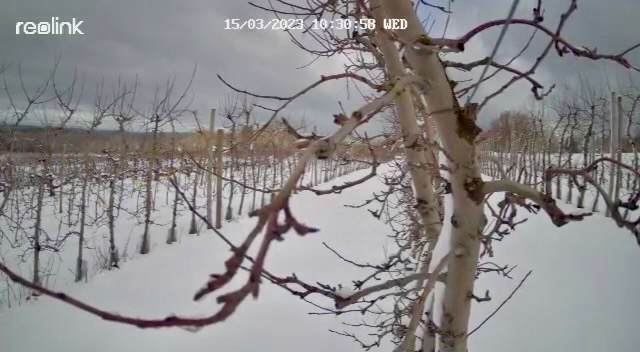
Looks like the most snow we had all winter on 15-March.
Northeast PGR meeting 7, 8-March, Wilkes Barre, PA. The group toasts PGR meeting fixtures of past who passed in 2023, Butch Palmer, and Jeff Alicandro. I think Jeff would approve.
Welcome to Lewiston, Maine. Although I love the place... one smart daughter of mine went to Bates College.
April
Struggled a bit here to come up with memories. Oh yea, pruned my quad-v peaches hard (no crop). Planted NC-140 Porters Perfection cider apple trees with a little experimental overlay using Biosafe pre-plant program. First apple bloom was a little early?
Pruned quad-V peaches hard on 11-April to reduce height, what's to lose with no crop?
Zestar! first bloom on 24-April, a bit earlier than ideal...
NC-140 Porters Perfection apple rootstock planting ready to be planted. Unfortunately, this second batch to trees -- after Fedex lost my first batch -- were less than ideal in uniformity.
May
Ugh, things were looking good until May 18. Apple bloom was the first week. OK. Things were looking pretty good. Did my first drone flyovers using the Outfield-Orchard Management Platform to map apple blossom density. Post-May 18, when the temperature dropped to 28 F. during late petal fall to fruit set, it got pretty depressing. Oh well, there is always 2024. Carnegie Melon University (CMU) crew plugged away with their robot at the UMass Orchard despite the freeze-damaged apples.
View from up above of apple block in bloom on 2-May at UMass Orchard. Outfield makes novice pilot like me (upper right) looks pretty competent. No crashes (yet).
Gala apple cluster on 23-May is hosed from the May 18 freeze.
CMU with their robot measuring apple fruitlet size using computer vision to attempt to predict fruit set. Hampered by the freeze though, had to move out of this frozen Honeycrisp block.
Zestar! (left) and Honeycrisp fruitlets severely damaged post-18-May freeze event.
June
Fire blight -- result of May 18 freeeze trauma event -- first visited, then stuck around (uninvited). Quick visit to see orchards and friends in MN/WI. By the end of June, rootstock bark failure in several orchards was coming to light resulting in tree decline. Not good.
Fire blight symptoms first observed on 5-June, then it got worse on Crimson Crisp by end of month.
Joe Ferguson, yours truly, and Thomas Bernard at Ferguson's Pepin Heights orchard overlooking Mississippi River/Lake Pepin.
Rootstock shank bark failure was becoming commonplace in several orchards by end of June, mostly M.9 and several Geneva rootstocks, resulting in apple tree decline by tree girdling.
Overlooking the Minas Basin from the "Lookoff" in Canning, Nova Scotia, Canada, 24-July
August
Attended Reality Research/MAIA field day out in Wayne County, NY. Midwest Apple Improvement Association arguably the biggest apple breeder/tester in North America now? Dr. Jason Londo from Cornell visits to look at rootstock/tree decline issues in Massachusetts. We are all still scratching our heads but lead theory is winter cold damage.
Bill Pitts discusses new MAIA apple 'Sweet MAIA' (among many other things); apple selection test plot planted by Reality Research/MAIA, pretty ambitious IMHO.
Physiologist Jason Londo from Cornell examines rootstock failure at the UMass Orchard in Belchertown, MA on 1-September, Londo had visited orchards on 31-August so this counts as August :-)
September
Not much happened here, althought it was alternately hot (92 F. on 6- and 7-September, as hot as it got all summer) and wet (9-10 inches of rain!). Wrapped up 2014 NC-140 Honeycrisp planting over several picks, it was no fun giving the condition of the apples (freeze damage, rots, inadequate thinning, oh no!)
Fruit Surface Temperature on Honeycrisp apples on 7-September, not quite high enough for sunburn damage on apples.
It was wet, wet, wet!
It's a wrap says 'Suaz' with final harvest (after 10 years) of 2014 NC-140 Honeycrisp trial at UMass Orchard, quality was 'meh' so it was a bit of a slog.
October
Depending on site, apple crop was generally better than expected after the May freeze event. But it was far from perfect. First and second of five meetings/trips stretching into December.
Lee Kalcsits from Washington State University discusses tree decline issues at Tougas Family Farm in Northboro, MA on 11-October. Lee was a guest speaker at the UMass Cranberry Station in Wareham, his topic bitter pit of apples. How'd that happen? Maybe had something to do with Giverson Mupambi being his post-doc at WSU?
With some persimmon trees outside the Musser Fruit Research Center prior to attending the MyIPM app working group meeing at Clemson University, 3-October. My rental wheels while there had Massachusetts plated, glad I didn't get pulled over by 'Smokie!'
The UMass 'fruit team' along with colleagues from NY and CT hike 'The Pinnacle' outside of Bolton Landing, Lake George, NY prior to our annual New York/New England/Canada IPM working group meeting at the Fort William Henry Lodge and Resort in Lake George, NY (23- and 24-October).
Despite the tough year for growing apples, these Suncrisp look pretty good on 30-October at the UMass Orchard in Belchertown.
November
Meetings 3 and 4, Great Lakes Fruit Workers (GLFW) centered in Buffalo, NY and NC-140 rootstock research project annual meeting in Holland, MI. Gave two talks at GLFW -- one on apple tree decline and one on my work with Outfield (drone). Keynote address by retired (and highly respected) Cornell entomologist Art Agnello at Clarksburg Cider (which was yummy). Agnello's address was both entertaing (humorous) as well as serious considering some of the groundbreaking apple IPM work done by Art and his colleagues at Cornell over the past 40 (+/-) years. At NC-140 presented our Massachusetts state report and had a nice-day tour of Michigan State University Clarksville and Southwest Michigan (Benton Harbor, my old stomping grounds) fruit research stations. Oh yea, I snuck in a talk at the Connecticut Pomological Society Meeting in Middleton, CT on 'Honeycrisp disorders' and I started one cut pruning on most of my older apple variety (not going anywhere) plantings at the UMass Orchard in Belchertown. Several reasons for this, I won't go into the details... 👎
Art Agnello keynote at GLFW, Clarksburg Cider, 2-November. Art is a true professional IMHO and I greatly respect him.
NC-140 group at MSU's Clarksville horticultural research station on 7-November where we visited the Great Lakes Cider Apple Collection.
One-cut pruning by me commenced on 21-November at the UMass Orchard.
December
May have been the trip of a lifetime, off to Australia to attend the ISHS Symposium Precision Management of Orchards and Vineyards (PMOV). Way too much to detail here, but you may want to look at the Book of Abstracts. And I survived driving on the wrong side of the road without an incident! (I learned my lesson pretty quick while driving wrong way once shortly after leaving the Melbourne airport, fortunately a grassy turnaround once I realized my mistake when I saw the white arrow on the pavement pointing in the direction -- wrong way -- I was driving!) The highlight of my trip was the weekend after PMOV spent with Garry Langford in Hobart where he treated me to an amazing tour of the surrounding area. Alas, I think we spent way more time sightsseing than looking at orchards in Tasmania, but that was just fine and dandy with me. Hobart is a great little city if you every have the opporutunity, go there! And thanks Garry for the Aussie hospitality!
With Luca Corelli at PMOV. Luca was on the ISHS Symposium scientific committee and a long-time fruit researcher at the University of Bologna, Italy.
Sweet cherries with rain covers and apples on 10-December near Grove, Tasmania. Cherries have been very lucrative (Asian export market) in recent years for growers there, allowing investment in modern, multi-leader apple plantings.
Garry and Jon atop Mt. Wellington (1,271 meters above seal level) on 9-December, Hobart city in the background.
I have a Flickr photo album with full res pictures of all of the above and a few more bonus pics.
Yea, this is pretty half-baked all right, but meaning to look and summarize it for quite some time now, recently pushed by colleague Win Cowgill to look at B.10 in this data set based on a recent publication suggesting B.10 was really good at NOT having bitter pit with Honeycrisp as the scion. Humph...
OK, so this work was part of a much larger NC-140 sub-trial honchoed by Cornell's Terence Robinson and WSU's Lee Kalcsits to assess the incidence of bitter pit on Honeycrisp as affected by (many) rootstocks in two NC-140 Honeycrisp plantings, 2010 and 2014. In addition to percent bitter pit in the apples as I will line out below, apple peels were also sent off to Lee for nutrient analysis and Lee and his/our team are working on a real scientific publication (not half-baked) which I will try to update here when it comes out.
For the purposes of my results presented below, basically, 50 Honeycrisp apples (or less if there were not that many on the trees) were evaluated for bitter pit at harvest and after three months regular cold storage. These apples were on trees in the 2010 and 2014 NC-140 plantings at the UMass Orchard in Belchertown. And this was done in 2019 and 2020, although in 2019 the crop was light and there were not enough apples in the 2014 planting to evaluate for bitter pit. You will see what the rootstocks are included in the results. When evaluating the apples for bitter pit incidence, no evaluation was made for severity of bitter pit, apples either had bitter pit (1 or more pits) or not (zero pits). Got it?
OK, so here are the results, pretty self-explanatory, but then I will bullet-list caveats and my take-homes after. 😉 Note you can click on any of the tables/graphs to get a larger image if these are difficult to read (too small) or blurry...
% Bitter Pit (BP) at harvest in 2019 in the 2010 NC-140 Honeycrisp apple rootstock planting. Capital letters (A, B, etc.) mean there is a siginificant difference when %BP is not followed by the same capital letter(s).
% Bitter Pit (BP) after 3 months cold storage in 2019 in the 2010 NC-140 Honeycrisp apple rootstock planting.
% Bitter Pit (BP) at harvest in 2020 in the 2010 NC-140 Honeycrisp apple rootstock planting.
% Bitter Pit (BP) after 3 months cold storage in 2020 in the 2010 NC-140 Honeycrisp apple rootstock planting.
% Bitter Pit (BP) at harvest in 2020 in the 2014 NC-140 Honeycrisp apple rootstock planting. Capital letters (A, B, etc.) mean there is a siginificant difference when %BP is not followed by the same capital letter(s).
% Bitter Pit (BP) after 3 months cold storage in 2020 in the 2014 NC-140 Honeycrisp apple rootstock planting. Capital letters (A, B, etc.) mean there is a siginificant difference when %BP is not followed by the same capital letter(s).
OK, let's unpack this:
Although some general and obvious conclusions about rootstock effect on bitter pit incidence can be drawn here, there was missing data and different numbers of apples evaluated, i.e. not always 50 apples were available, so don't take these results to the bank. What follows though, I am pretty confident about saying.
In the 2010 planting, in both 2019 and 2020, the only time there was a significant difference in % BP by rootstock was at harvest in 2019. There G.41 had significantly more BP than B.9, G.214, and the two M.9 clones. G.41, got that?
I have been trained to not go here, but may we conclude a few things on the non-significant results in the 2010 planting in both years, 2019 and 2020? Yes, I have my reasons. G.41 is generally in or near the top of the list in % BP. B.9 is generally low or near the bottom of the list in % BP. Hmmm... B.10 exhibits more BP than B.9 but generally expressed less BP than most of the Geneva rootstocks. (Sorry Win and Sherif.) G.214 among the Geneva rootstocks seems less bitter pit prone and comparable to B.9 and M.9. I don't know what to say about M.26 but I don't generally recommend that rootstock for Honeycrisp. My theory on all this is the Geneva rootstocks are generally more vigorous than B.9 and M.9, set a lighter crop, and thus are more likely to have BP'd apples? Plus I understand research has shown some issues with various ratios of nutrient (Ca, Mg, and K in particular) uptake among the rootstocks.
In the 2014 planting, there were significant differences in % BP vs. the rootstocks both at harvest and after 3 months cold storage. After cold storage, G.11 and G.41 were the worse but technically did not significantly differ from many of the other rootstocks. How come I did not have B.9 or B.10 in this planting? Good question. I clearly remember technician Jim (I miss him now) commenting when evaluating the bitter pit how bad the bitter pit was in the apples from the 11's and 41's. Also in terms of severity (how much bitter pit) he said which was not taken into account here. The vigorous V. (Vineland) rootstocks were generally pretty bad, and once again, among the Geneva rootstocks G.214 (4214) did not have that much bitter pit. I really like that rootstock, however, have been recently made aware of some winter hardiness issues with it.
For the reason mentioned above, Geneva rootstocks -- with maybe the exception of 214 -- are more pre-disposed compared to the less vigorous and heavy cropping (which has it's own downside) B.9. M.9's are in there with B.9 but might be more prone to bitter pit. The slightly more vigorous (than B.9) B.10 might be a better choice than G.11 or 41 with Honeycrisp (or any other bitter pit prone variety, Jonagold?) as the scion.
I have a saying "friends don't let friends plant Honeycrisp on G.41" largely based on my overall experience, including in a significant commerical planting of Royal Red Honeycrisp on G.41 where the bitter pit therein has just been untenable (to date). And this is a good grower, the planting otherwise looks spectacular, although the crops have been lighter than desired. Oh wait, until 2023. Which has looked a lot better, very little bitter pit in that block. But a heavier crop and a very wet summer? And I understand the grower really threw the calcium at them this year after last years ugly look. I also have noted that my NC-140 Honecyrisp trees seem to have a lot less bitter pit than last year. This year's weather effect and a heavier crop? Or maybe as the trees get older they are settling down more? Although this is the 10th leaf, BP was bad last year in the 9th leaf. So I will temper a bit my saying above going forward. And there are obvious benefits to using Geneva rootstocks.
Seems to me I had some other things on my mind regarding this BP issue, but that is enough and this is about as half-baked as it gets, but it also is what it is, and my field observations kind of align with the numbers which don't lie? You just have to question the procedures 🤣 and do some of your own unpacking... 😎
To Nova Scotia, July 23-25. Oh yea, maybe I am getting older or just think I have seen it all, I was not particulary inspired to report on my attendance at this IFTA event, but I suppose I need to earn my keep. It was also kind of hot and sunny, which does not particulalry motivate me either, but once I get going it jogs my memory and kind of enjoy documenting it. Although glad when I finish it!
The 2023 IFTA Summer Study Tour was based in Wolfville, Nova Scotia at the Old Orchard Inn where we were treated Sunday July 23 with a hearty reception on arrival -- food that is, otherwise a cash bar, but I have always enjoyed an (or 2 or 3) Alexander Keith's IPA. Monday morning the 24th we (approximately 120 of us) boarded three buses at 7:30 AM (6:30 EDT) for orchard visits in the Annapolis Valley. What fun!
First orchard stop was Birchleigh Farms in Berwick where our host was owner Waldo Walsh. Waldo grows for Scotian Gold where he "farms 100 acres of orchard (apples and pears) with apples representing over 95% of the production. The predominant apple varieties grown on the farm are Honeycrisp, Minneiska (SweeTango), Gala and Ambrosia." Focus of this stop however was Keith Fuller, research scientist for Agriculture and Agri-Food Canada (AAFC) out of Kentville. A project here in collaboration with Nova Scotia Federation of Agriculture "Living Lab" Agriculture Climate Solutions was using Pic Plus Fumigant as a replacement for Telone C-17 in apple replant situations. Fuller's results to-date suggest Pic Plus is useful to improve tree growth in true replant disease situations, but still not as effective as if Telone C-17 was used.
AAFC's Keith Fuller at Birchleigh Farms talk replant disease treatment
Replant disease at Birchley Farms? Looks pretty good to me...
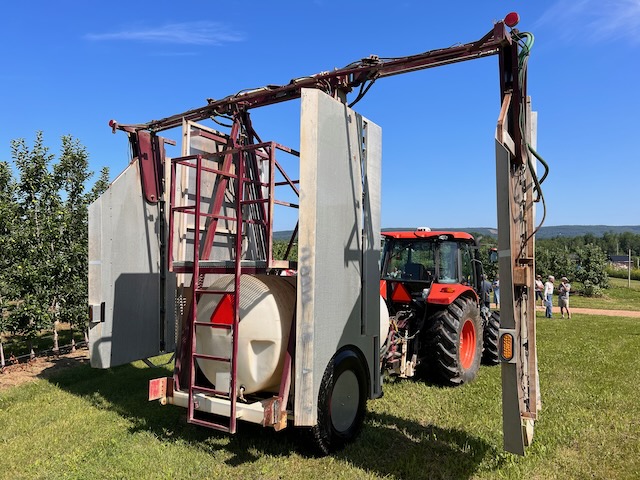
Next up CAP Farms where Andy Parker (the "P" in CAP?), son-in-law Eric Chappel, and Scotian Gold's Danny Davison discussed management of a hi-density Ambrosia planting including their homemade over-the-row sprayer. C Andrew Parker Farm grows for Give Them aWink, "Wink" being a brand of Van Meekeren Farms, also home of Pazazz apples in Canada. Of particular note is the fact their over-the-row sprayer had no fan assist which apparently is not necessarily in their well-sculpted (hedged) rows of apples. No complaints here.
Fanless custom-built over-the-row sprayer at CAP Farms
Nicely sculpted (heged?) apple trees at CAP Farms
Very healthy-looking Ambrosia at CAP Farms
After a chicken BBQ lunch (yum) at the Northville Farm Heritage Centre we walked (literally) to a bi-axe (Honeycrisp?) block at Van Meekeren Farms being shepherded (babied?) by Harrison VanMeekeren. Unfortunately cropping has been light to date on these Geneva rootstocks. (Which one?, I really should be taking notes!). I was not surprised. Also a hot and sunny equipment demonstration, most notably an autonomously equipped/operated GOtrack tractor. Among other toys by ProduceTech.
Multi-leader Honeycrisp at VanMeekeren Farms
Last (not really) afternoon stop was at Vermeulen Farms looking at raised bed strawberries (not really into it) and a lively farm labor discussion. Not even a picture for you here. Really the LAST afternoon stop was the mandatory group picture from "The Lookoff," overlooking the Annapolis Valley and Minas Basin. Shameless self-promotion picture here but the real group picture here. Second mandatory IFTA Nova Scotia stop was a lobster supper (chicken optional, eh?) at the Louis Millet Community Complex in New Minas. For some reason can't help but think about Evangeline here.
Selfie from "The Lookoff" overlooking Minas Basin
Tuesday, the 25th of July. Lutz Family Farm Ltd. first on the agenda, our hosts being Larry Lutz, son-in-law Cassian Ferlatte, son Sam, and their Jamaican farm crew. Lutz Family Farm owns over 1,000 acres of land with only 140 acres of orchard, Larry equally likes his winter work of land clearing/logging. Apple rootstocks and Ambrosia pruning were the focus here, but also a thinning trial with Accede was highlighted by Michelle Cortens of Perennia. Take homes? M.26 still in favor in Nova Scotia, although Geneva rootstocks are being planted with some trepidation. Lutz is using Supporter 4 too, and has an on-farm nursery producing ten to twenty thousand trees annually. Prune Ambrosia hard using longish stubb cuts to prevent growth from becoming upright, long and lanky away from the central leader. Accede has promise as a thinner at larger fruitlet sizes, but like all chemical thinning, it's a bit variable in efficacy. If you have eleven minutes, check out my video interview with Larry here, it's a pretty good story.
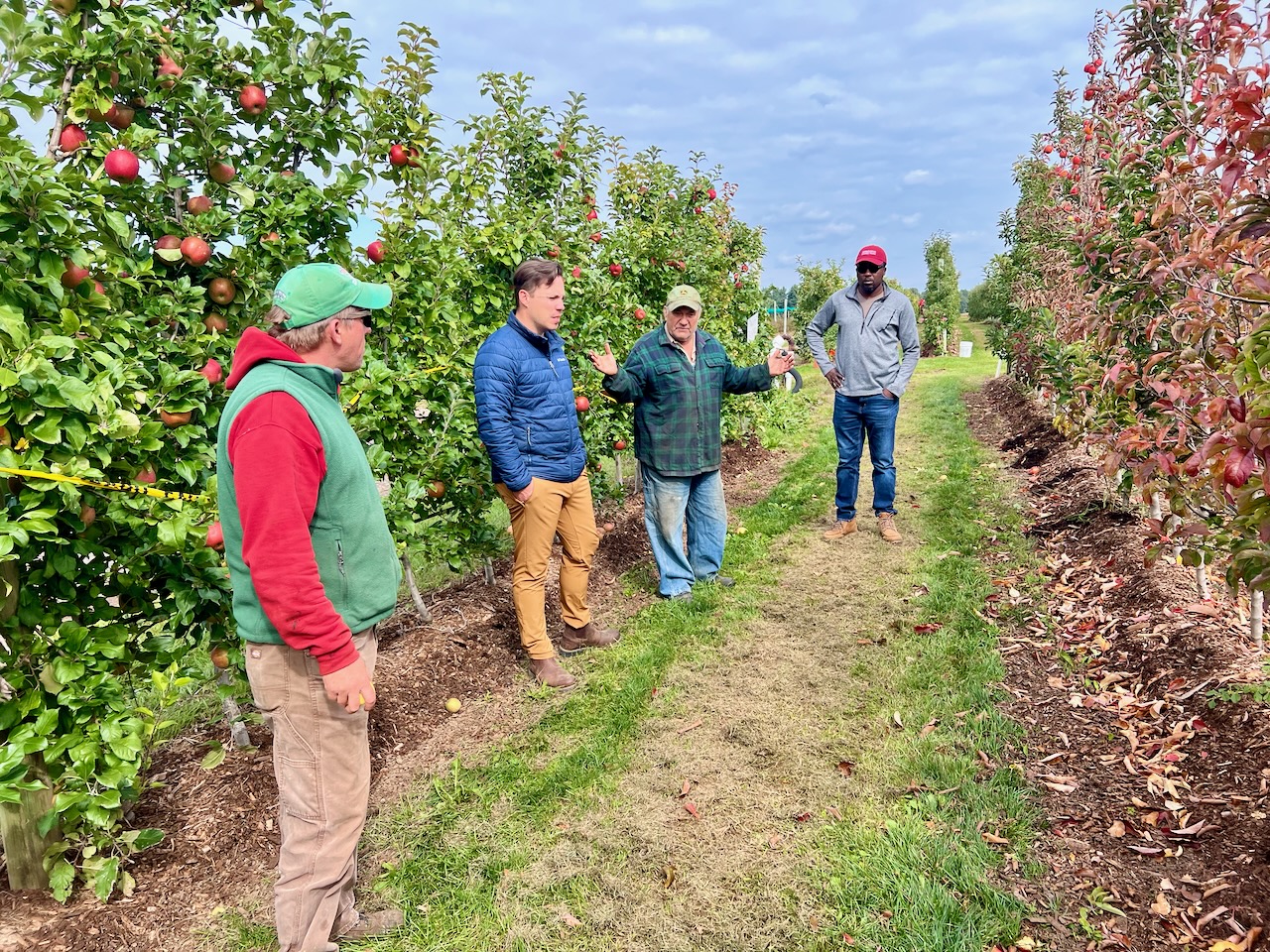
At Lutz Family Farm Ltd, Sam, Larry, and Cassian field attendee questions
Lutz nursery, 'Rave' bench grafts on G.935 (Larry Lutz photo)
Valent crew and Perennia's Michelle Cortens discuss thinning with Accede
I'd say Accede worked pretty good on these Honeycrisp!
Second morning stop was Crisp Growers Inc. owned Scotian Gold and their fourteen apple growing families. Kind of an interesting (but slightly dated) story here. But we were only here to see the H.S.S AgBot sprayer and Vivid Machines crop load management vision technology (aka camera mounted on an ATV). That AgBot is kind of scary, check out the video, what could go wrong? 😑
After a Jamaican food truck lunch (yum) and cider tasting (double yum) at Spurr Brothers Farm Market, we followed Lisa Jenereaux to Spurr Brothers Farm to look at V pears (sorry Lisa, I was not really into it) and another replant experiment being honchoed by Keith Fuller, this one being mulching (with and without fumigation) to improve newly planted tree growth. To date results are lackluster explained Keith, as tree growth in general in the first two seasons was poor, and compost and fumigaiton with Pic Plus did not improve tree growth. But pre-plant compost addition suppressed root leasion nematodes and compost presisted for 4+ years after planting as measured by soil C content. Oh well.
Lisa Jenereaux at Spurr Brothers Farms talking about her pears.
Final IFTA Nova Scotia 2023 Summer Tour stop was the impecably manicured Wohlgemuth Farms where pre-harvest leaf removal to improve red color and NC-140 rootstock trials (2019 Buckeye Gala) were showcased by AAFC Kentville personnel. Also some of their research on effect of anti-ethylene products ReTain and Harvista and optimum harvest window of Ambrosia and Honeycrisp apples. Nice orchard, good research, overall a fitting Tour finale. Did I mention they are a hog farmer also?
Pneumatic leaf removal experiment to improve red fruit color at Wohlgemuth Farms
I have come to the conclusion that hog farmers have the nicest orchard!
Suzanne Blatt, AAFC Kenville entomologist, does double duty as a horticulturist while discussing the 2019 Buckeye Gala NC-140 planting at Wohlgemuth Farms
The 2019 Buckeye Gala NC-140 planting (on left)
That's about all I got, maybe all apple trees are starting to look alike, but I have to say, the longer I am in this business the more confused I get (about some things). I can confidently say though that Nova Scotia is a pretty darn good place to grow quality apples -- particularly Honeycrisp, they are absolutely the best there -- but they do have these tropical storms that in recent years have caused them some headaches! Thanks to all who planned and hosted us, best of luck to you during the upcoming harvest!
I think there is Scotian Gold at the end of the rainbow as seen from the Old Orchard (note foreground apple trees) Inn