Carrying on tradition of posting about my International Fruit Tree Association (#ifruittree) trips, this time Grand Rapids, MI. I tweeted a bit about the Conference speakers over two days, there were - how should I say politely? - the good talks and the not so good talks, but that is OK. Here I will post a bit about the orchard tour stops, again, a mixed bag IMHO, I'm just calling it as I see it! So here goes...
First stop, Riveridge Land Company "a vertically-integrated company that operates over 860 acres of orchards." Apples and cherries, both metallic V-trellis a la what you see a lot of in Washington. It was OK, but those things cost a lot of money to establish. All things being equal, V-trellis intercepts a lot of sunlight per acre, hence can lead to maximum production per acre. But there are a lot of "gotcha's" IMHO, including training trees (to tie or not to tie?), and in the case of cherries, canker issues. I thought, especially with the cherries, a lot going on here. Cherry variety was "Skeena," apples were Honey's and Fuji's? But the main attraction were the Voen "rain" covers also serving as frost protection with "included" Voen gravity-fed pellet heaters at 20 per acre. Got the impression was both quite effective at preventing frost/freeze damage and preventing rain cracking. Apparently Riverridge has a good wholesale packing and marketing strategy, however, exactly how profitable the whole thing -- covered, hi-density sweet cherries in a humid/lower light environment such as Michigan -- is remains elusive? On the side, I was told they (Riveridge) may be moving to a UFO-style narrow canopy sweet cherry orchard, higher quality cherries and simpler management in that planar canopy? Did I mention we looked at apples on the V-trellis too, likely a better bet, unless organic? 😅
V-trellis cherries at Riveridge with 'Voen' rain/frost/freeze prevention covers
Gravity-fed wood pellet heater to further prevent frost/freeze damage, part of the Voen system
V-trellis apple orchard at Riveridge Land Company
Yup, organic apples at Riveridge. 80 acres. Major issues? Lack of tree growth/vigor compared to conventional, organic fertility (particularly nitrogen) always being a bugaboo. Weed control using landscape fabric leading to vole damage. I had to ask, what about mechanical cultivation as is so common in Europe? (No particularly good answer.) Pest control challenges (plum curculio, scab) such that much of the fruit goes to processing. But apparently demand exceeds supply, and there is a premium paid for organic processing apples, baby food? I got the impression Riveridge was doing it to broaden their portfolio as a supplier so they could offer organic as well as conventional to their customers? A bit of greenwashing? Maybe. Although there was some discussion about the larger organic ideals of soil health, organic pest control, etc. by guest Kyle Rasch of Tom Rasch & Son Orchards.
80-acre organic apple block at Riveridge
Vole damage exacerbated by fabric landscape cloth for weed control in organic orchard (photo courtesy Andre Tougas)
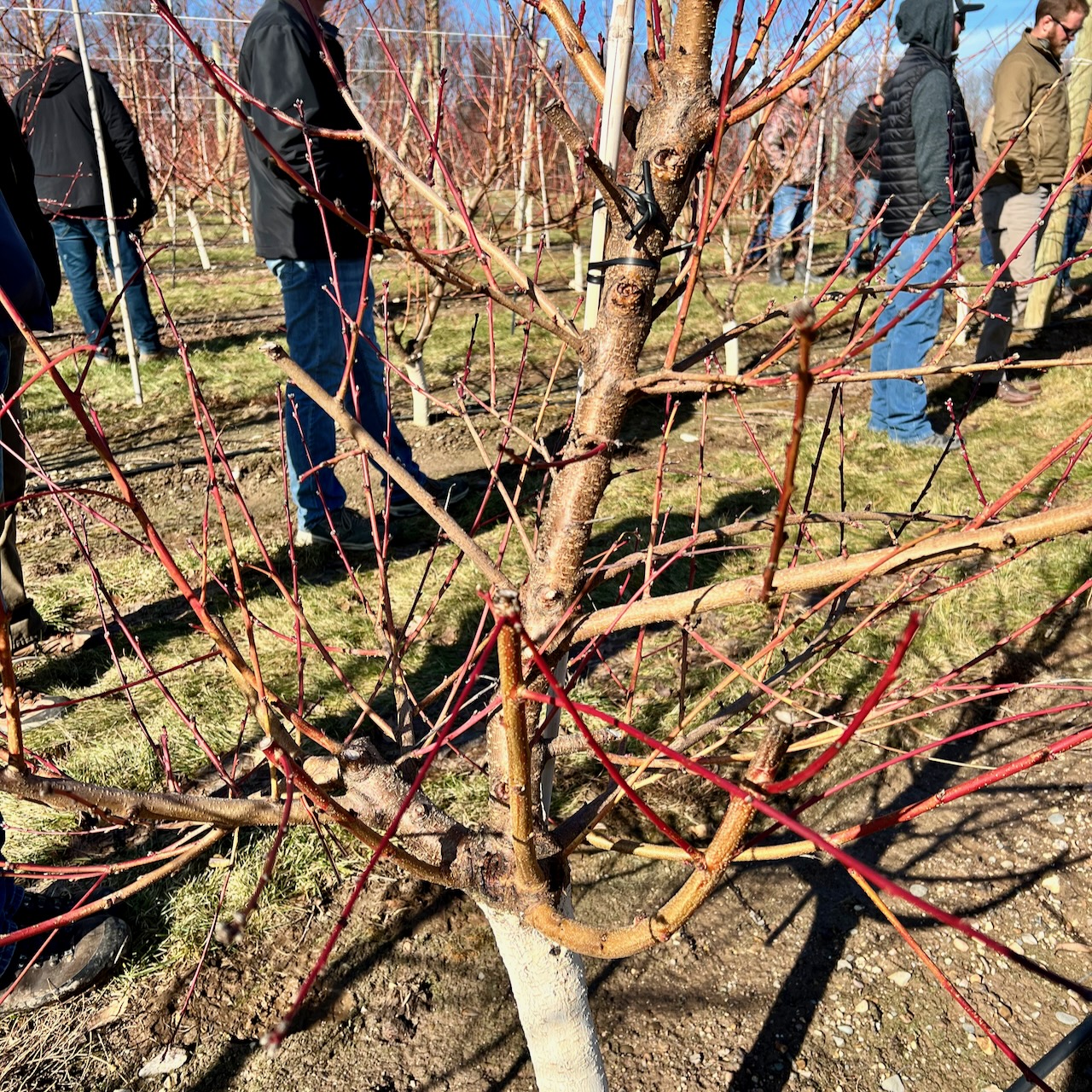
On to Rasch Family Orchards. (Yea, there are a lot of Rasch's out there on the "ridge." And Dietrich's 😂.) Hosted by "characters wanted" Jake Rasch in their hi-density peach block. I couldn't help myself thinking they've been drinking the Greg Lang Kool-Aid! Walking up the hill I saw some pretty nice looking perpendicular-V peaches, but we were looking at a planar V-system with wires, tying, etc. Rationale, according to Jake was better peach quality (mostly red color), labor efficiencies (platforms), and it did not take that much more work than the Perp-V's? Maybe, I could buy that, and am generally an advocate of hi-density tree fruit production, but I worry about within-the-row shading and -- as with all peach systems -- maintaining a properly sufficient light environment in the bottom of the trees. Remember, no really proven dwarfing rootstocks for peaches yet, so it's pretty hard to make a big tree "small." I already saw some pruning messes? Might be better off dispersing the vigor more into Upright-Fruiting-Offshoots, UFO? That can continually be renewed? But I will give Jake the benefit of the doubt for now...mostly because he was just good-humored about the whole thing!
Pruning and training demo by Jake Rasch in planar 'V' peach system.
Ugh! What now Jake Rasch?
After BBQ lunch at a Riveridge pack house we re-assembled in an apple orchard newly aquired by LTI (Let's Try It) Ag Research. Hosted by LTI founder Tye Wittenbach and his righ-hand person Dan Zemaitis. LTI "was founded in 2021 by a group of like-minded industry professionals who identified a need for on-farm research in the apple industry. LTI will focus on membership-driven research of industry problems that face growers each season." The focus here at LTI was a just-planted "apple rootstock evaluation in a replant scenario." Two things stuck out to me: first, lots of replication but absolutely no randomization in terms of experimental design; and second, pretty lousy trees with very few branches. After the fact it's easy to criticise, but either at the nursery or when planted some effort should have been made to promote braching in these young apple trees. Now they are in a situation where they got to get some branches growing on older (2 or three years) wood, which is not easy. Much discusssion about ensued. Maybe it was exacerbated by the replant effect too? Whatever, I would not be happy if it was MY orchard...
LTI's 'Let's Try It' apple replant 'experiment.'
"Where's the branches?" These trees at LTI were somewhat neglected in the nursery and in the first year in the orchard where some intervention (PGR's) could have helped prevent the blind wood seen here.
Last stop of our day was J. Engelsma Orchard at Engelsma's Apple Cider Barn, Michigan's best "blue ribbon" cider pressed fresh daily. Bridget Engelsma gave us a quick tour of the cidery, but then we followed Jim Engelsma out to a young block of Honeycrisp/B.9 trained to two leaders. I remember these "whip" trees were headed low at planting to get the two leaders, and now the struggle is to get to the top wire (at 9-10 feet) on that weak rootstock. Getting there, but not quite, and Jim admitted, might never happen. Jim's proposed pruning on these trees was done in a couple rows, mostly shortening "click" style pruning of last year's shoot growth to keep the trees planar and set flower buds closer to the trunk? At least that is what I took home, I think Jim's ultimate solution will be using a mechanical hedger with some annual dormant hand-pruning of bigger wood. Should be easy 😎
It was a cold, frosty morning when Andre Tougas took this picture (thanks Andre!) of Jim Engelsma's bi-leader Honeycrisp/B.9 block
OK, enought of me being "negative Nancy" (or so I am told), thanks to IFTA Education Director Greg Lang, the local Michigan State University crew (Amy Irish-Brown, Anna Wallis, Emily Lavely, Derek Plotkowski, Phil Schwallier [retired], and Todd Einhorn), and Ag Association Management (Shane, Shari, Bethany) for hosting, educating, and humoring all 300 or so of us IFTA'rs. Lest me not forget the couple of freeloaders on my tour bus looking for free food and a warm place to spend the day, they succeeded in pulling the wool over my eyes! 👻
Precision Apple Crop load MANagement (PACMAN) is the topic of our time. Seriously, it is. Although I have to be a jack of all trades (pest management included) my heart lies in horticulture. And technology. (Although I am no computer geek like some people think I am!) So, I have been interested in the fruitlet growth rate model per Duane Greene et al for quite some time including onerous measuring of fruitlets for quite a few years.
The fruitlet growth rate model is one part of PACMAN which also includes precision pruning, blossom thinning with caustics, chemical fruitlet thinning, and finally – if necessary – hand thinning. Why? Because, particularly when growing high value varieties like Honeycrisp – or where size matters even more, like Gala – it’s money you are otherwise leaving on the table. (Thanks Rod Farrow for that bit of wisdom).
So, carry on, here is what I did for PACMAN in 2022. My main objective was to compare the fruitlet growth rate model when measurements were put into Malusim (MS app) vs. the Ferri-Fruit Growth model ‘FG’ app. In addition, and to make it more complicated of course, Farm Vision (FV) was in the mix. (And I later realized it’s a bit like comparing apples to oranges though. More on that later.) I’m going to lay it out here pretty tersely for you to digest and form your own opinion on the value of using the fruitlet growth rate model as part of your PACMAN strategy going forward. Which I do recommend, with caveats as you will see.
METHOD
At the UMass Orchard (UMO) I chose Gala, Fuji, and Honeycrisp. Per my RECIPE for predicting fruit set, five representative trees were selected at bloom, number of flower clusters counted on each tree (for potential fruit set), fourteen flower clusters tagged per each of the five trees for fruitlet measurements beginning when fruitlets were app. 6-7 mm in size on 23-May and continuing subsequently on 26-May, 29-May, and lastly on 3-June, 2022. Unfortunately, although chemical thinners were applied, the details are sketchy and date of application(s) not included here for UMO.
Ditto for Tougas Family Farm (TFF) Northboro, MA for Gala and Honeycrisp, although over only three measurement dates: 21-May, 25-May, and 27-May, 2022. Here, chemical thinner application dates are noted in the results.
At both UMO and TFF, sometime between August and harvest the number of apples left on each tree were counted for the final fruit set. All make sense so far? Oh wait, on each measurement date I also did a Farm Vision (FV) scan using their provided equipment: smart phone, stereo video camera, and enhanced GPS location. And also did a final FV fruit scan to determine the fruit set in August.
FV scan on 3-Jun, 2022 at UMO, Fuji
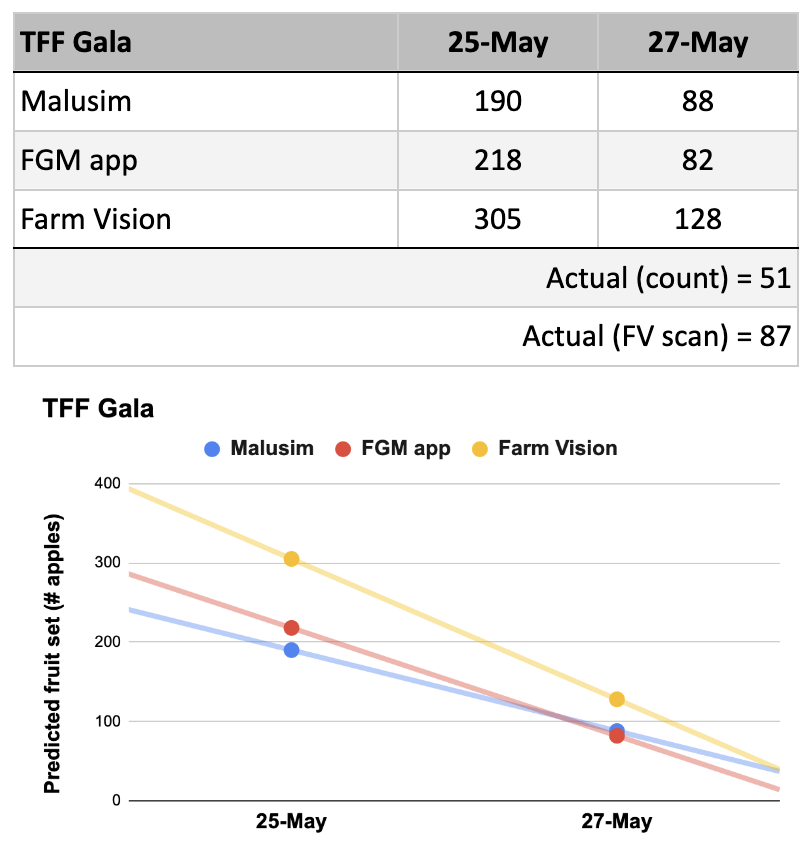
There, now the results are presented in both tabular and chart form (Figures 1. through 5.). Ought to be self-explanatory, but we will see 🙂 and more explanation will be included as it’s not always really pretty…
RESULTS
Figure 1. - Predicted fruit set Gala at UMO
A bit of explanation here which applies to all the Figures. There was one measurement date previous to all the initial measurement date(s) noted in Figure 1. (and Figures 2. through 5.). But that is not included because in Malusim there is no prediction. (No growth rate calculated on first measurement.) Otherwise, on the dates noted, those numbers in the tables are predicted fruit set (number of apples per tree) based on Malusim, the FGM app, and Farm Vision. Actual (count) in the Table was the number of apples hand counted (per tree) in mid-August. (Except for UMO Honeycrisp in mid-September.) Actual (FV scan) was what FV 'saw' on the trees mid-August. So you can compare that Actual fruit set to the Predicted fruit set on the last date of fruitlet measurements. Charts are table data visualized. All make sense now?
Gala-specific at UMO (Figure 1.), these trees are on M.9 rootstock, fully mature, tall-spindle. Bloom was spotty but five trees with approximate equal (and good) bloom density were selected. The overall objective here was to compare Malusim and FGM app when the same numbers were used. You can see they differed a bit. Why? Measurements were made by different people (on at least one date), and that could have accounted for some 'increased' predicted fruit set noted on 29-May. (That should not happen!) Advice: same person should measure on each date to keep that source of measurement error down with more consistent measurement technique (hopefully). Farm Vision here was in the ball park. Oh, one more thing, not sure I am using the trend line appropriately, but I like it here...😉
OK, onward with the rest of the RESULTS (Figures 2. through 5.), with brief variety-location-specific comments.
Figure 2. - Predicted fruit set Fuji at UMO
Same story as Gala here with these Fuji (M.9 rootstock), with that uptick of predicted fruit set on 29-May, different measurement people, student interns? Malusim and FGM app were quite different at the end (3-Jun), FGM being right on compared to Actual (count). I should note that Malusim has instituted some error correction and will exclude measurements deemed to be outside specific error limits (too large, too fast growth rate). Not sure I like it because I think at least here it might have been discarding measurements that were indeed valid? Not sure, but perception is reality? Again, Farm Vision, at least on the last measurement date, predicted more fruit setting than Actual. Is this necessarily a bad thing as some fruit will continue to fall off, June drop, etc. I told you it was a bit ugly, but I am not casting any shadows yet after just one season of evaluation of Farm Vision. (BTW, they are now part of Meter Group/Pometa.)
Figure 3. - Predicted fruit set Honeycrisp at UMO
At least Malusim, FGM app, and FV align pretty good here with these Honeycrisp on G.11 rootstock in their 9th-leaf. Actual (count) may be an underestimate as there were some drops which were not counted. But not so many to skew the results too badly IMHO.
Figure 4. Predicted fruit set Gala at TFF
At TFF there were only three (total) measurement dates for both Gala (Figure 4.) and Honeycrisp (Figure 5.). Hence only two dates of Predicted fruit set. These Gala were mature tall-spindles on G. 41. I do have some thinning information here, thinners were applied to these trees on 12-May (Promalin + AmidThin, bloom) and 20-May (Maxcel). But I was not worried about using the Predicted fruit set to help with thinning times and rates, at least here, where the objective was to just compare what the three tools were doing in predicting the fruit set. Got it?
Figure 5. Predicted fruit set Honeycrisp at TFF
Thinning regimen here on these Honeycrisp/G.41 was NAA (4 oz.) on 12-May, NAA (4 oz.) plus carbaryl (one pint) on 18-May, and NAA (2 oz.) on 27-May. No Farm Vision here, the equipment was not behaving properly. (Except for the Actual FVT scan.) Malusim and FGM app were close, but not close enough. As an aside, bitter pit was really bad in this light cropped block of Honeycrisp on G.41. Did I say G.41? (Friends don’t let friends plant Honeycrisp on G.41.)
I have to say that 2022 was overall just plain weird, I mean the weather during the post-bloom period made chemical thinning applications a nail biting experience. What we saw and what happened kind of defied expectation. It was not a 'normal' year. (As if we ever have one?) Can't wait to see what 2023 brings... 😱
RECOMMENDATION
There you go, make of it what you will, there is lots more to dive into. But, I do know this is what I would do: follow the RECIPE using the FGM app. iPhone only unfortunately. Malusim has issues, although I do like the website interface. The app, not so much. But it does more than predict fruit set, and I hear it is being updated to include fixed voice input recognition in 2023. After the initial set up, it takes less than an hour (easily) to do the measurements (per variety per block) using the RECIPE instructions. Preferably with two people. And you get instant results via the FGM app, i.e. predicted fruit set to better inform further chemical thinning decisions. Period. One side effect often observed, is the actual physical process of measuring fruitlets gives better insight over time as to what is going on -- what is growing, and what is not -- that you otherwise get from simple observation from the truck window!
But, Farm Vision (now Meter Group/Pometa) has merits in its early stages. Plus it gives you a crop estimate later in the season for better harvest management. Lots of potential there, and it – or similar tools (FruitScout?) – are the future of precision apple crop load management. Well, then there are rovers and drones, but I don't go there, I let others. Flip-flop, check out Orchard Robotics. And here's a couple videos from Farm Vision you might get a kick out of. I did, reviewing them here in January 2023 when it is otherwise pretty bleak outside. Good luck in 2023...
UMass Orchard Gala - Farm Vision fruitlet scan on 26-May, 2022
The FRUIT GROWTH (FG) app by Joe Ferri – and mentored by his grower brother Tom of TK Ferri Orchard, The Blue Mountains, Ontario, CANADA – is an iPhone/iPad (only, no Android) app that does just what it says: predict apple fruit set based on the apple fruitlet growth rate model. Per the description on the App Store (https://apps.apple.com/us/app/fruit-growth/id1604255929), the FG app features:
Easy fruitlet size and cluster count input screens.
Quick apple set prediction results screen.
Full results easily shared to email addresses and Mac computers.
The Fruit Growth app accepts fruitlet sizes and cluster counts data to calculate the predicted number of apples that will be set.
The results are summarized in the calculated results screen. The full results Summary file (.csv) can be shared to an email address, internal device storage or air dropped to a Mac computer.
The fruitlet size Data file (.csv) can be shared for cut and paste to the Excel Fruit Growth Model (Ferri version).
I used the FG app in 2022 to predict fruit set in two Gala blocks, two Honeycrisp blocks, and one Fuji block. (Across two orchards, results forthcoming in a pending Fruit Notes article.) I found it generally easy to use and once fruitlet growth measurements are made on a given date it gives instant results predicted fruit set so further chemical thinning decisions can be made. One feature of the FG app allows you to do a split tree (top and bottom) calculation predicting fruit set. As you probably know, fruit set is often better in the tops of trees vs. the bottom. Thus you can target and be more effective with your thinning sprays. Below are a few screenshots from my FG app in 2022 (Figs. 1 - 3), and there are a set of excellent screenshots on the App Store (https://apps.apple.com/us/app/fruit-growth/id1604255929) so you can better understand how it works. For reference, per the Ferri’s, here are their specific notes on how to use the FG app once you download and install:
Fruit Growth Model Notes (Rev 3.0.0)
Select a Variety - to input the fruitlet sizes (Fig. 2)
Input the fruitlet size and Enter button
For fruitlet size measurement accuracy of 0.5 mm (e.g. if 12 is entered 12.0 is stored, if 12. is entered 12.5 is stored)
Note: Once all current measurements are completed, to advance for the next sample date and measurements push the blue right arrow next to the date
When each tree fruitlet measurements are completed:
Enter Clusters button - to input the number of clusters per tree
Input the cluster count and Enter button
If two people are counting the clusters, use the + button to add the counts
Note: To delete all the last sample fruitlet sizes and cluster counts push the Trash button
Add Variety button (Fig. 1)
Enter the variety name
Choose the number of trees to measure
Choose the split or full tree option
(Clusters: Tree Bottom 1-6, Tree Top 7-14)
Save button - save the file name and settings
Manage Files button (Fig. 1)
Select a Variety
Results button - generate the results summary (Fig. 3)
Share Summary button- generate the full results summary .csv file
Delete button - permanently deleted the file
Import Data button - import a fruitlet size Data.csv file
Share Data button - generate the fruitlet size data .csv file
(used to cut / paste into the Excel Fruit Growth Model (Ferri) version)
Joe Ferri is actively updating the FG app, it is up to version 3.0.0. You can download from the App Store, it costs $17.99 but is money well spent. Alone, once set up (see my RECIPE for setting up your trees for using the FG app: https://ag.umass.edu/fruit/fact-sheets/hrt-recipe-predicting-fruit-set-using-fruitlet-growth-rate-model) I can complete a set of measurements per variety/block on a given date in less than an hour. It would go quicker with two people, and you get instant results predicting the fruit set. How good is that?
Wow, my third International Fruit Tree Association (IFTA) event in 2022. Annual Conference in Hershey, PA in February, Summer Tour in Washington in July, and now just back (as I start wring this anyways) from Italy Study Tour, November 11-19. And we covered a lot of ground -- Bologna, to Venice, to Bolzano, to Milan. Some orchard visits but a good dose of bus time, tourist stops, and trade shows. I posted a real time highlight from each orchard stop on the IFTA Facebook page, I will bounce off those with more detail here, including a bit of one tourist stop for your entertainment.
Starting off in Bologna, spent a day at EIMA International 22, the International Agriculture and Gardening Machinery Exhibition. Simply huge, mostly indoors, many themed buildings. I found a couple toys I wanted, of course I have no money, but it was fun looking. I should mention on arriving in Bologna we -- approximately 150 of us on the Study Tour -- were treated to a visit and dinner at FICO Eataly World. No, not misspelled, apparently Eataly's are a thing that originated in Italy (Eataly, Italy, get it)? Eataly's are in major USA cities too, including an online store. Who would've known?
Little boy in toy store?
While still in Bologna, in lieu of spending another day at EIMA, I chose to go with Greg Lang (IFTA Education Director) and a sub-group of circa 40 grower-attendees to (one of) the University of Bologna research farm(s). First stop with Assistant Professor Luigi “GiGi” Manfrini was to look at various peach multi-leader/variety training blocks. Hmmm, interesting, I have to say there were a lot of questions here, not always answered, but our host definitely expressed some frustration with tree establishment and getting those many-leaders (certainly called UFO in stone fruit?) going at uniform spacing and size. I got the impression it was a hands-on experiment. IMHO peaches will be a challenge growing anything other than some kind of 2-4-6 scaffold steep leader because I think they largely grow like "weeds."
GiGi in the multi-leader peach experiment
We also looked at some apples, first with Professor Luca Corelli Grappadelli, an experimental block of trees where the primary objective was disease control (scab and fire blight) by covering the orchard thus eliminating "wetness." Unsure how successful it was, but I did notice wooly apple aphid seems to love that protected environment. Corelli also showed us a rover/robot with autonomous navigation they are working on with an industry partner, purported to have multi-functionality (sensors, flail mowing, etc.) and there was some discussion with him and GiGi about a "smart specialized sustainable" orchard. And GiGi showed us a multi-leader (UFO or 'guyotte') apple system trial, it looked pretty good, I am thinking UFO looks better in apples than stone fruit? And, first detecting a theme here, the sustainable smart orchard and multi-leader trees, we/you will see more...
Luca Corelli Grappadelli in the covered apple orchard
GiGi shows us his nice multi-leader apple trees
OK, enough of Bologna, departed and on way to Venice we did a couple orchard stops. First a cherry variety/training system by Salvi Vivai nursery. It was interesting, and I could relate, but not sure what my take-home is/was? Makes me want to grow cherries again, but planting them very close together (SSA?) and on Gisela 3 or 5 rootstocks (depending on variety)? (Note to self: don't be a glutton for punishment, just-don't-do-it!)
Jacopa Diamanti shows us Salvi Vivia's cherry experiment
And then a significant planting of 'Rosy Glow' Pink Lady (Cripps Pink cv.) which had not been harvested yet. (Or it might have been first picked?) This was at the Mazzoni Group, a large multi-crop agriculture farm and fruit tree nursery. Again with some different training systems, bi-baum, guyotte(?), etc. Sorry for lacking detail here. I could not help wonder with the heavy crop load if there would be return bloom? Interestingly, fruit cracking was a significant issue, I assume because of the rather wet spring and early summer weather they seem to have? It was worse they said in tops of trees.
Mazzoni's Michele Gerin starts our tour of their large orchard, mostly Pink Lady and Fuji still on the trees
'Rosy Glow' Pink Lady experimental/production block covered with hail net
Crop load not as heavy as I thought, but I don't like that cracking!
In the afternoon, we visited C.I.V. - Consorzio Italiano Vivaisti, apple and strawberry breeders "we enhance nature" and nursery. Think CIVG 198 Modi®. Oh, what can I say? Focusing on "sweet and sustainable" varieties. I'd say half or more of the new apples they showed us were scab-resistant. We taste-tested a dozen or so new apple varieties in their portfolio, many of them numbered so not in orchard production yet. They ranged from "meh" to "pretty good." And got a look at some of their larger plantings for variety evaluation. We could look but not touch... 😎
CIV's Marzio Zaccarini leads us in apple variety tasting and tour of variety field evaluation orchard
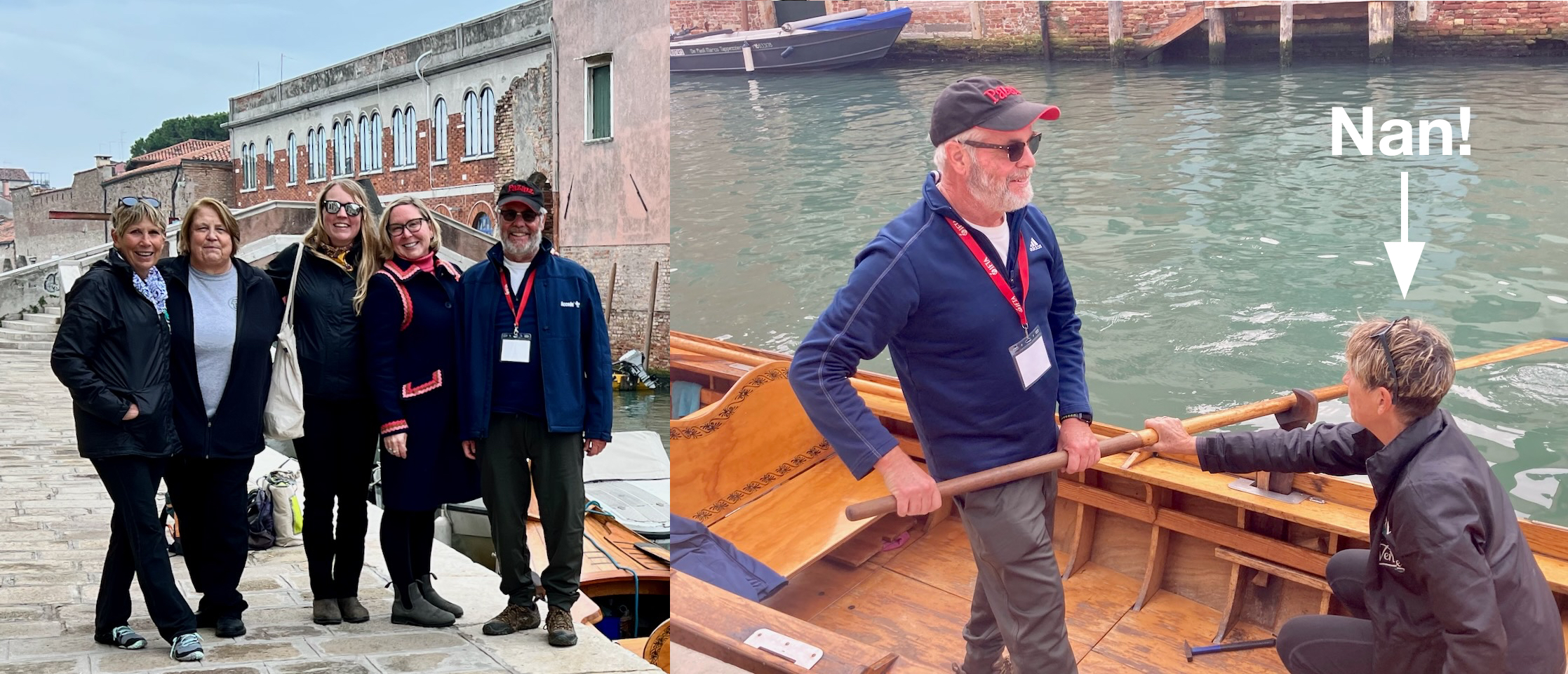
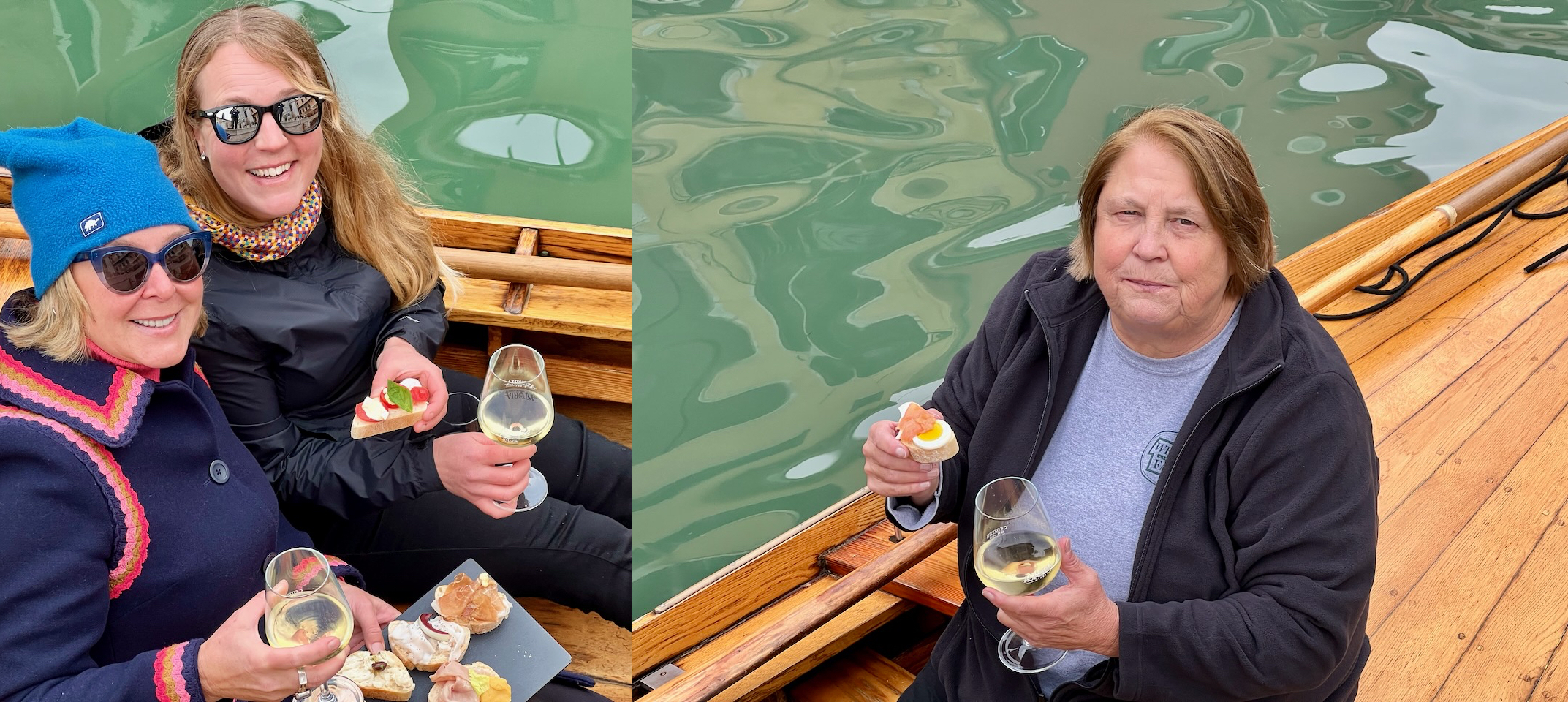
So then, a free day in Venice. While in Venice, one must row to get around, seriously, there are no roads on the island of Venice. So how about a Cicchetto Row with Row Venice and these four jolly rowers, left to right -- Nan, our instructor, not unlike a Marine drill sargeant who was always on your case about your rowing technique, high five! 😅 -- and Marge, Molly, and Nicky. We all got the rowing down for a good 5 minutes straight (w/o being corrected by Nan!), rowing our way to some Prosecco, wine, and Cicchetto from a local bàcaro...or two!
Nan and the Row Venice crew
Nicky, Molly, and Marge enjoy the Cicchetto
Departing Venice headed to Bolzano, we had a choice of going on a just apples (Jeff Cleveringa lead) or an apple-cherry tour (Greg Lang lead). Actually being a glutton for punishment, I chose the apple-cherry tour. Sorry, lacking many details here, but I will do my best. First stop was an experimental orchard site that (apparently) was a collaboration of Societa Cooperative Agricola and the Edmund Mach Foundation, which "promotes and carries out research, scientific experiments, education and training activities as well as providing technical assistance and extension services to companies." We got a talk about apple production practices in the Trento region from Tommaso Pantezzi, Centro Trasferimento Tecnologico, Fondazione Edmund Mach – Instituto Agrario San Michele all’Adige, and Nicola Andreatti, from Fondazione Edmund Mach. (It might, however, be the grower whose orchard we were in according to Greg Lang?) Also, we saw MORE multi-leader 'guyotte' style apple trees!
Tomasso Pantezzi and Nicola Andretti inform on apple production practices in Trento region including here a producting multi-leader block
For the cherry stop, up the road a ways, we were (after a long hike uphill) hosted by Angela Gottardell, Centro Trasferimento Tecnologico, Fondazione Edmund Mach – Instituto Agrario San Michele all’Adige in a cherry systems trial. The usual suspects, spindle, bi-axis, KGB (Kym Green Bush), and SSA (super slender axe). Looked like SSA and bi-axis were outperforming (in terms of cumulative production) the KGB and spindle. Would have been very interesting to see these trees pre-harvest, hint, maybe a summer tour to Italy is called for?
Angela Gottardell hosted and explained results at a stop in a cherry systems researchrch block
Last orchard stop before landing in Bozano was the Laimburg Research Centre. After an introduction by Dr. Walter Guerra head of the Institute for Fruit Growing and Viticulture, three research orchard block vists stood out. First, the Laimburg Integrated Digital Orchard, LIDO for short. Not to be confused with LIDAR, LIDO is an outdoor orchard 'laboratory' focusing on "the latest, state-of-the-art technology available on the market." Just planted with 'Rosy Glow' Pink Lady trained as 'guyotrees' the orchard was equipped with all sorts of sensors communicating over a long range low power wireless network. Also an overhead, fixed spraying set up for pest control. Checked all my boxes. Next a robotic harvester was a big hit with the group, however, it was in a test stage demo mode, yup, it picked apples. That's all I can say. Far more interesting to me was the training system demo by Dr. Christian Andergassen, fruit physiologist at Laimburg. There he was comparing apple yield and quality of Fuji and Pink Lady apples grown to traditional (for Italy) tall-spindle vs. various multi-leader approaches, including 'bi-baum' and 'guyotree.' Bottom line through the early production years? Fruit quality and yield was superior in the many-leader 'guyotree' system. He pointed out, however, that it depends on variety, Fuji being more vigorous and being less suitable to many leaders than Pink Lady. I think anyways...
LIDO, the Laimburg Integrated Digital Orchard, an outdoor laboratory
Dr. Christian Andergassen in his Laimburg multi-leader apple experiment
So, we finally made it to Interpoma 2022, the apple trade show. Words can't quite describe, suffice it to say it is THE International trade show about all things apple and pear, but of course with a focus on what's going on Italy-centric. I should do a word cloud about Interpoma. Wait, maybe I will! Followed by a few picts from the venue, Fiere Bolzano...
What could go wrong? Everything!
The apple variety "garden" at Interpoma
Lunch at Interpoma with my orchard friends from India, Vikram and Kunaal. Thanks guys!
Apple variety booths are a staple at Interpoma and quite flashy!
The "GuyoTree." Do they come like that?
Lots of equipment, platforms rule. N. Blossi is a local favorite?
I do want to thank IFTA (of course), Onward Travel (Molly, Kat, and Barbara), Greg Lang (IFTA Education Director), Jeff Cleveringa (IFTA President) for putting this altogether and (mostly) pulling it off without a hitch. 150 are a lot to herd and keep happy. Highly recommended if you have the opportunity to go on a future IFTA International Study Tour led by Onward Travel, wherever you go? (Hint: Norway, South Africa?) And thanks to Jim Krupa for putting up with me as his roommate for eight nights!