Wednesday, February 23, 2022

IFTA 65th Annual Conference, Hershey, PA: Orchard Post-Tour Brief

The International Fruit Tree Association (IFTA) held it's 65th Annual Conference in Hershey, PA from February 13-15, 2022. Orchard tour day was Monday, February 14. Cold and windy, but mostly sunny, true to IFTA fashion. (Cold and windy, not so sure about the sunny part?) I will have to admit, I was not terribly well engaged, I was dealing with everyone's earbuds and the speakers transmitter device so everyone could hear. Not terribly sold on it when the crowd is on the small side, there were 4 buses total, and mostly each orchard stop had only one bus, about 35 people. Sometimes I wonder if those earbuds do not foster engagement particulary well either? I would opt for the more traditional mic and speaker when the crowd is small. (Or have the speaker speak up? It's not that hard.) Oh well, enough of my complaining. I will give you a brief rundown of what I/we saw on the tour.

First stop, Penn State Fruit Research & Extension Center (FRAC, fitting for Pennsylvania, if you know what I mean), where Dr. Jim Schupp talked about his peach rootstock and hi-density peach plantings. The rootstock trial was planted in 2017 with Cresthaven as the variety trained to a Perpendicular-V. It looked good, Schupp says Controller 6, 7, and 8 reduce tree size somewhat at 80-90% compared to Lovell rootstock, and they are all about the same size to date. (Controller 6 "should" be smaller though.) Rootpac 40 and MP-29 are pretty dwarfing, 66% and 31% of Lovell respectively, and will likely need some kind of support as scaffold breakage and drooping are a problem. FYI, this is an NC-140 Regional Rootstock Research Project, more info here.) Speaking of support, Schupp also showed us a young hi-density peach planting, the rootstocks escape me, but trees were planted very close together and to a Perpendicular-V. Schupp was experimenting with removal of one of the scaffolds on alternating (every 2-3 years?) basis to renew the scaffold(s) and prevent the lower part of the trees from becoming shaded and non-productive. He wanted to make a pedestrian peach orchard. The scaffolds were supported by a T-post type trellis with two wires (about head height). I did not particularly like it, I say good luck.

Dr. Jim Schupp, NC-140 peach rootstock planting at FREC

A pedestrian peach orchard? Really Jim? Kind of an oxymoron isn't it?

At FREC we also checked in with Dr. Long He's crew (aka grad students) in the engineering shed where each presented their project, including: robotic pruning and green fruit thinning, sensors in the orchard (Internet of Things, IoT), intelligent spraying, and imaging of fruit buds, flower clusters, and fruit(lets) using a Moog data "rover" ATV (part of PACMAN). Interesting stuff, some maybe a bit far-fetched? But that is what University researchers do, don't they?

I thought the drones and heat mapping were pretty cool. I envision drones could easily scout large areas, report back to the home base for further investigation by real eyes?

Dr. He shows us the Moog data rover, the ultimate goal being gainful adoption of precision crop load management

Stop two, Hollabaugh Bros. Inc. market and orchard. Their family run market is well known in the area, since 1955, and has the usual bakery, apples, groceries, and gift shop. There was a "bee" room which I gather is popular with the kids? It was popular with me as the cider donuts and coffee were served there... :-) Because it was Valentine's Day, I noted some were picking up gifts for their significant other. In the Hollabuagh Bros. orchard, well, I don't remember a whole lot, a mature semi-dwarf pear block, they like the fire blight resistant pears from Ontario, Harrow Sweet and Cold Snap? An on-farm peach rootstock planting sponsored by the Penn State Extension folks, Hollabaugh's being one of 12 farms with the planting of Controller 6, 7, 8 and Krymsk 86 with PF Lucky 13 on top. And some tall-spindle apples, generally looking good, but with some talk about fire blight history and M.9 rootstocks. Some active pruning was going on by the Hollabaugh orchard crew on a platform. BTW, during the Conference, attendees unanomously agreed a platform was the number one peice of "technology" that every orchard should have. Did I say it was cold and windy, and the cider donuts were beckoning?

Bruce (and father Brad listening) at Hollabaugh Bros. Inc. orchard. Mature talls-spindle apples, Gala, Fuji, Honeycrisp. More trees missing on M.9 than other rootstocks. Otherwise, no complaints here.

After lunch at the local Biglersville fire station -- it was very good, need I say more -- it was a quick hop to Rice Fruit Company. Usually packing house stops are quite ho-hum for me, but the Rice team did a good job showing us their pre-sorter operation, packing line, mesmerizing robotic technology (video below, and they do not take a coffee and donut break, unlike me!), and a bit about their marketing and who they pack apples for. Including Ocean Crisp Apples Honeycrisp out of Nova Scotia. Interesting. Not much to say here except Rice has kept up with innovation in the apple packing business, and the younger generation is slowly taking over running the show. Which reminds me, we got a demo of StemPunk by Leighton Rice, a wearable stem "clipper" while picking Honeycrisp (and other?) apples.

OK, finishing up the tour at Mt. Ridge Farms with father David and son Blake Slaybaugh. David showed us his "workshop." Jaw-droppingly well outfitted with lots of new "toys" and clean. Very impressive. While inside we also got a demo of Noble Orchards Software Solutions recordkeeping application. Out in the orchard with Blake we got into a bit of discussion about pruning, we felt they were not removing enough branches wholesale while leaning more toards cutting them back, the bud load seemed to high and could be corrected by wholesale removal of more branches? Plus, M.9 was showing more tree mortality, call it RAD/SAD whatever, but I put two and two together and call it fire blight in the M.9 rootstock. Oh, did I mention that Premier Honeycrisp was found here? I think that helps explain all the new shop toys! :-)

Blake Slaybaugh. Pruning is always a source of good (conflicting?) dialog on IFTA tours! But it's all good!

That's about all I got, short and sweet, it was a good tour and the best thing was time spent on the buses was minimal, all the orchards were in Adams County and the Biglerville area, and it was less than an hour from Conference central at the Hershey Lodge. The downside of that of course, is not much nap time on the bus. And thanks to Jen Baugher our bus leader. Check out my Twitter feed if you want to see some of the Conference presenters slides (along with my comments). Or search the hashtag #ifruittree on Twitter for more. For 2023, here we come Grand Rapids...




Thursday, January 13, 2022

Half-baked Research 2021: Part 4 - More Precision Cropload Management (aka precision thinning)


 I'm a bit tired of talking about precision thinning (and precision crop load management), have written up much about it in the past:

You get the idea, but, I am always looking for that "magic bullet" to make it more accurate and my life easier. To that end, I tried to follow in 2021 the exact RECIPE as described above. The details:

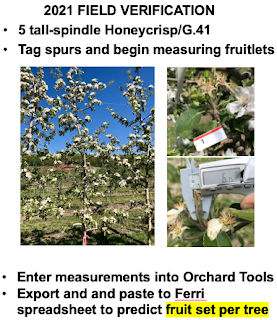
  • six Honeycrisp trees selected on G.11 rootstock in our 2014 NC-140 Honeycrisp planting at the UMass Orchard in Belchertown, MA
  • 14 flower clusterd tagged and whole tree bloom counted
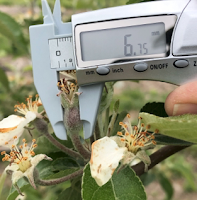
  • measuring of fruitlets began on 18-May, and were measured 5 more times at 2-3 day intervals (average persisting fruit size on 21-May was 9.2 mm) until the last measurement on 4- June (7 days after the previous measurement, average fruit size of persisting fruits was 24.2 mm)
  • at first, measurements were voice-entered into the Malusim app, however, once it got "flakey" I switched to using the Orchard Tools app, which worked very well.
  • used the Malusim app at first to predict fruit set, however, quickly discovered there were some issues in the way erroneous (too big or too small) measurements were being handled and thrown out, switched to the Ferri spreadsheet, although I did not use the tree top and bottom distinction.

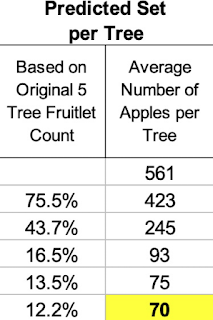
Here is the result from the Ferri spreadsheet and I think it was quite accurate. It's a no-brainer to follow this RECIPE for tall spindle trees and apples of high value such as Honeycrisp, Gala, and Fiji. I'll admit I did not follow it to guide my chemical thinner applications, because someone else chose the rates and timing and made the applications on their schedule. But it worked out.

Actual number of apples per tree at harvest 61! Pretty close to 70 predicted!

So, what's half-baked about it? Well, myself and colleagues at UMass (Dan Cooley and PhD student Paul O'Connor to be exact) are collaborating with researchers at Carnegie Melon University (CMU) on a NIFA funded project: Using Computer Vision to Improve Data Input for Precision Thinning Models in Apples. I pushed for them to use the RECIPE while doing their study of computer vision to measure fruit growth, and on two other varieties (Gala and Fuji) and another Honeycrisp block. So they did, with the exception is that all data was collected by pen and paper, but thanks to our summer help (Evan Krause), was entered and imported into the Ferri spreadsheet to predict fruit set. OK. I ran the model in the Ferri spreadsheet and came up with some very low fruit set numbers. I won't even show you that here, because although it was more-or-less field evaluated, it was by observation only. Even though I believe final fruit set was counted, the data entry source escapes us at this time. (Arghh.) Here was the problem, the student plucked spur leaves off tagged spurs to assist with the computer vision, and I believe that resulted in very poor fruit set (compared to the rest of the tree) on those hobbled spurs. (Hasn't someone a long, long time ago stressed the importance of healthy spur leaves for susbsequent fruit set and size/quality?) It's too bad because otherwise had the help to do a nice set of fruitlet measurements to run in the fruitlet growth rate model. Next year? No half-baked research? (Maybe?) But thankfully -- both to me as the writer and you the reader? -- this is the last half-baked research for 2021!

YouTube video of May 19, 2021 Twilight Meeting at UMass Orchard with CMU robot


Friday, January 7, 2022

Half-baked Research 2021: Part 3 - In Search of the Optimum Honeycrisp Bitter Pit Reduction "Diet!"

 Honeycrisp is arguably the poster child for bitter pit. (With the exception of Cortland, but who would want to grow those anyways? LOL.) Bitter pit reduces packout of saleable fresh fruit significantly in some years, up to 50%. And you can put otherwise good looking (no bitter pit) Honeycrisp in storage and then  when pulled out of storage a couple months later you go home crying.

Much has been researched and written on Honeycrisp bitter pit management (reduction), however, the problem is nowhere near totally solved. Nutrients in the skin and flesh of Honeycrisp apples – particularly nitrogen, calcium, and potassium – may play an important role, but there are many other factors including growing season weather, crop load, tree vigor, etc., those are all players too. Read more in "It's the calcium stupid!"

But nutrition was the factor fully “looked at” but not really fully “evaluated” in 2021. By “looked at” I mean multiple leaf and fruit nutrient analyses using different analysis vendors, including industry and University testing labs. Let me outline what these were, and then attempt to make some sense of the results and how it might relate to bitter pit incidence. But I’ll tell you up front, Honeycrisp exhibited quite a bit of bitter pit starting pre-harvest in 2021, part of which I blame on a very wet summer and very large apples. All samples were collected from the UMass Orchard in Belchertown, MA, and I don’t consider our nutrition program specifically targeting BP all that much. So let’s see what tissue samples I/we collected and then what nutrient analyses results might have told us?

First, how/what/where tissue (and fruit) samples were collected and sent for analyses:

  • Agro-K (Minneapolis, MN) has been promoting their leaf SAP analyses to existing and potential customers. Leaf samples – from older and younger leaves individually on terminal growth, enough leaves to fill a one quart zip-loc bag, and without petioles – are collected in the morning and shipped overnight (via FEDEX) to a lab in the Netherlands (NovaCrop). There were three collection dates for Honeycrisp: 15-June, 19-July, and 10-August. Oh, leaves were collected off Honeycrisp on G.11 rootstock, which has been problematic for bitter pit in the past. 
  • Peel SAP analysis by the Cornell Nutrient Lab and Lailiang Cheng’s lab at Cornell AgriTech in Geneva, NY. Honeycrisp fruit samples (about 30 apples, off the same trees on G.11, and I also did G.41 to compare) were collected in early July when the fruits were 50 to 60 grams. The apples were peeled and the peels frozen prior to delivery to Cornell for the analysis. (Thanks to Mike Basedow for meeting me in the Hudson Valley and ultimately getting those frozen samples to Geneva.) I received the results back in mid-August, which included Ca, K, Mg, N (all ppm), and K/Ca, (K+Mg)/Ca and N/Ca ratios.
  • Dan Donahue’s Environment Minerals Rootstock (EMR) bitter pit analysis out of Cornell’s Hudson Valley Commercial Hort Program. Honeycrisp fruits (app. 12, off both the G.11 and G.41 rootstocks) were collected in early August, peeled, and the peels sent off to Dan to forward to the Cornell Nutritional Analysis Lab in Ithaca. Results were back by mid-September and included the % of apples expected to have bitter pit developing in a month or two of cold storage.
  • Various fruit and tissue samples were also sent off to two independent labs, Waypoint Analytical and SoilTech NW Ag Testing Services (analyses by Brookside Labs). Waypoint is open to anyone but SoilTech only to consultants by invitation. Basic mineral analyses with recommendations were performed, I will try to summarize the results below.

So here we go in an attempt to summarize the results of all the samples submitted to the various labs for analyses. And some snapshots of what the results looked like from each testing service.

Leaf SAP analysis – indicated there were generally few problems. The SAP analyses are quite comprehensive, including a listing of 24 line items, some not normally included in nutrient analysis, such as Total Sugars, pH, sodium, cobalt, and nitrogen in 4 forms (ammonium, nitrate, N in nitrate, and Total Nitrogen). Most nutrients were in the optimum range, with these exceptions: Fe (iron) was consistently low (is that a problem?); nitrate nitrogen and boron were high; and total sugars were high (indicates the plant is really cranking?) Remember, samples were collected over three dates and from old and new leaves on the shoots. Verdict out on this one, but over time might be very useful in quickly remedying problems or indicating you are doing a good job with nutrient management. Below in Figure 1 is a snapshot of the NovaCrop result but here is a full report if you want to see it.

Figure 1 - Portion of NovaCrop SAP analysis result

Peel SAP Analysis – courtesy of Cornell (thanks Terence Robinson and Lailiang Cheng), interesting and disheartening result when you see RED (as below in Figure 2) in the cells. RED usually means bad things compared to GREEN and YELLOW doesn’t it? But not too surprising, and probably a good analysis that I would buy based on field observation. And it aligned with the EMR results next…

Figure 2 - Peel SAP Analysis interpretation courtesy of Terence Robinson and Lailian Cheng

Environment Minerals Rootstock (EMR) – similar to Peel SAP Analysis, a bitter pit buffet. Suggests nearly a third (for G.41 at least, one out of 5 apples for G.11, bad enough) of the Honeycrisp will come out of storage with some bitter pit as seen in Figure 3. Not good. Nor did I verify that result unfortunately. Hence half-baked.

Figure 3 - Dan Donahue's (Cornell) EMR bitter pit prediction

Waypoint Analytical is my latest go-to for leaf analysis with the apparent demise of University soils and tissue testing labs? Waypoint provides a quick turn-around of results including a nice graphical output (Figure 4). For this years Honeycrisp/G.11 leaf analysis, well, it looked pretty good overall. The only nutrient judged deficient by Waypoint was Potassium. But I’d like to see Nitrogen trending towards the Low side, while Calcium would be on the high Sufficient side. See the whole PLANT ANALYSIS here.

Figure 4 - Portion of Waypoint analytical tissue (leaf) analysis output

And finally, SoilTech NW, which was a whole fruit analysis. SoilTech NW is a testing service by invite only as I mentioned, I have been using it in a collaboration with a managed apple variety. I really like their output, and they have developed their own set of desired nutrient ranges based on their database of samples over many years. The result here kind of mirrors the Waypoint leaf analysis, mostly in Nitrogen being high and Calcium low (Figure 5). Magnesium is kind of high too. All things being equal, Magnesium and Potassium are antagonistic to Calcium uptake, and with high Nitrogen it’s not a good outlook for bitter pit. Or do I mean it’s a good outlook for bitter pit, and a not so good outlook for storage potential as can be seen here in the complete results.

Figue 5 - Graphical interpretation of SoilTech NW fruit nutrient analysis

So, all things considered, I/we could have done better when managing nutrients in Honeycrisp for reduced bitter pit in 2021. There’s always next year, but remember there are many other factors affecting bitter pit incidence in Honeycrisp, primarily tree vigor (overly vigorous, excessive pruning), cropload (lighter with bigger fruit means more bitter pit), tree age (younger trees more susceptible), and high nitrogen/low calcium ratios. And in the Northeast, it was generally a high bitter pit year, the wet growing season (large apples and diluted calcium content) likely being the primary reason. But there is always room for improvement in nutrient management, and doing leaf and fruit nutrient analyses no matter which lab you use is necessary information to improve your orchard bitter pit reduction diet.


Friday, December 31, 2021

ACCEDE Experimental Use Permit in Massachusetts in 2021 (and what to expect in 2022)

 In late 2020 Valent Biosciences received Federal registration for ACCEDE plant growth regulator. From their announcement “Accede is the first PGR based on a naturally occurring compound developed specifically for thinning of stone fruit, including peaches and nectarines. It also gives apple growers an effective tool to thin apples in the late thinning window when fruit are 15-20 mm in diameter. Until now, no fruit thinner has provided reliable thinning at this stage of development. Use of Accede will reduce the need for costly hand thinning to adjust the crop load and generate higher fruit quality and grower returns.” 

How does Accede work to thin apples and peaches? Accede (active ingredient 1-aminocyclopropane-1-carboxylic acid, ACC) is classified as a naturally occurring “biochemical” plant growth regulator. It is an immediate precursor to ethylene production. Application of Accede thus stimulates ethylene production which in turn triggers seed abortion and the formation of an abcission zone. Hence fruitlet drop (in apples when applied at 15-20 mm fruitlet diameter) and flower senescence (in peaches when applied at bloom) is promoted and accelerated. Application of ethephon can do the same thing, but ethephon is a bit “unpredictable” whereas Accede is a bit “safer.”

At the University of Massachusetts, Duane Greene started experimenting with ACC over 10 years ago. A couple years of trialing at the UMass Orchard in Belchertown on McIntosh apples resulted in significant fruit thinning that increased (less percent fruit set) with rate and with later timing (10 mm vs. 20 mm, Figure 1). He also noted some leaf yellowing/drop after Accede application, but it was not excessive. And Phil Schwallier at Michigan State University in 2016 showed that ACC application increased fruit size of Gala apples to 160 grams per apple compared to 120 grams per apple for untreated trees.

Figure 1 - 2011 results of ACC research at UMass Orchard (Duane Greene)

Lacking a state label in Massachusetts in 2021, I was asked by Valent to supervise Experimental Use Permit (EUP) applications of Accede in a handful of Massachusetts apple orchards. Valent applied for and received the EUP from the Massachusetts Department of Agricultural Resources (MDAR) in January 2021. Notable stipulations of the EUP included:

  • MDAR notified in writing prior to application
  • Supervised by Cat 49 (Research & Demonstration) applicator
  • Public access limited by signage “Notice Pesticide Testing”
  • Report submitted to MDAR at conclusion of EUP

With enough Accede on hand in the spring of 2021 to cover about five acres total, I solicited four Massachusetts orchards – one in the northeast, two in central Massachusetts, and one west of the Connecticut River – to use Accede under the EUP. I also intended to use Accede at the UMass Orchard in Belchertown. Along with Jim Wargo, Valent sales rep for New England and New York, visits were made to the orchards in late May to assess the need for further thinning after they had already applied their petal fall and 10 mm chemical thinners (Fig. 2). It was not too hard to settle on approximately one-half to one acre apple blocks where additional thinning was desired at 15-20 mm fruitlet size.

Figure 2 - Accede EUP application discussion with Jim Wargo (Valent USA) on 25-May, 2021

Valent supplied the directions for the growers to use when applying Accede under the EUP, including:

  • Use a rate of 200-400 ppm (23-46 fl oz/A) at 15-20 mm fruitlet diameter
  • Use a non-ionic surfactant at 0.05% v/v (6.5 fl oz/100 gal)
  • Use 100 gallons per acre (adequate coverage of fruit and foliage)
  • DO NOT apply as tank mix partner with other thinning products
  • Consider reduced rate if temperatures predicted to exceed 90 F. on day of application
  • And allow 7-10 days to observe effect of thinning

Growers were instructed to follow these directions the best they could, and applications were made around June 1. I should note that the NEWA Apple Carbohydrate model indicated a moderate deficit would be occurring shortly after most applications were made, so we expected to get some (good) results. Accede was applied to quite a few varieties, including Gala, Honeycrisp, Fuji, McIntosh, Cortland, Macoun, Golden Delicious, and Paulared (among a few others). Growers noted there were no particular problems mixing and applying Accede and most used LI-700 as the surfactant. The rate of Accede used was 300 to 400 ppm in 50 to 100 gallons of water. With the exception of Paulared and one Macoun block being larger trees, the rest of the blocks were smaller (150 gallons per acre dilute tree row volume approximately) but mature bearing trees on dwarfing rootstocks.

A few weeks following the Accede applications, a visit was made to each orchard to visually assess the efficacy (or not) of the Accede application(s). Valent provided a form that included the assessment parameters of leaf yellowing/drop, tree vigor, thinning activity, and return bloom (Fig. 3).

Figure 3 - Portion of assessment form provided by Valent to assess ACC applications

When assessments were complete, it was agreed that leaf yellowing-drop ranged from none to moderate, while tree vigor was generally good (slight reduction in canopy density) to excellent (no difference in tree canopy vs. untreated). Thinning activity varied widely by orchard and variety. As a general rule, Golden Delicious types (like Gala) were sufficiently thinned compared to the untreated control (Figs. 4 and 5) where little or no hand thinning was needed. McIntosh types seemed largely unfazed by the Accede application(s) though. This was also observed in an ACC experiment conducted on McIntosh by Greene where virtually no thinning occurred too. On Honeycrisp, it’s unclear how Accede may work, it may be useful there but still to be determined.

Figure 3 - Gala fruitlet drop following Accede application: untreated control on left vs. Accede application on right

Fig. 5 - Typical Gala fruitlet clusters after Accede application: untreated control on left, Accede application on right

We are learning how Accede may be another useful chemical thinner in your toolbox but don’t count on it being a silver bullet. Plan on starting chemical thinning early and often just as usual, and then bring out the Accede if you get to the point when fruitlets are 15-20 mm in size and you are looking at having to do considerable hand thinning still. Accede will probably not be a good option at the 10 mm fruit size, but that is still being evaluated. Having some carbohydrate deficit on the trees during the timing of Accede application will be helpful, and Accede may be particularly useful on Gala to increase thinning and improve apple size.

I alluded to the fact that Accede can also be used for thinning stone fruit, including peaches! That is a big deal as we don’t have a chemical thinner for peaches. And it’s a very promising thinner of peaches. For example, a summary of Accede EUP applied to peaches in 2021 in New York, Michigan, Ohio, and Pennsylvania across many peach varieties resulted in an average fruit reduction of 39% compared to the untreated control (Gregory Clarke, Valent USA). Peach varieties did vary quite widely in their thinning response to Accede, but that might have been a location effect. And in Michigan, work by Anna Wallis and Phil Schwallier in 2021 showed that hand thinning time was reduced by approximately 50% with Accede application compared to non-treated peaches. That would be sweet!

New York already has a state registration for Accede, on both apples and stone fruit, but as of late 2021 not all the New England states had Accede registered, including Massachusetts (per CDMS Advanced Label Search, which I really don't like, prefer Agrian, but Accede not listed there yet!). All state registrations, however, are expected in 2022. But I have learned that Accede supply for 2022 may be somewhat limited, and Valent plans to expand a demo program similar to what was done in 2021. Reach out to your agrochemical supplier if you want to use Accede in 2022, particularly if you want to trial it on some peaches.

Thanks to Parlee Farms, Carlson Orchards, Ragged Hill Orchard, and Clark Brothers Orchard for participating in the EUP. And to Jim Wargo and Greg Clarke of Valent for supporting the EUP in more ways than one. And Duane Greene for his preliminary work with ACC and for some worthy edits to the text herein...

Monday, December 27, 2021

Half-baked Research 2021: Part 2 - Lesson learned, don’t play with fire blight!

 Don’t play with matches. Don’t play with fire. Don’t play with fire blight! Lesson learned. Of course I had to prove it for myself, as in “Half-baked Research 2021: Part 2 - Lesson learned, don’t play with fire blight!”

I was approached in early 2021 by a notable “manufacturer and marketer of science-based nutritional and biological products that will enhance crop quality, storability, and yield in a profitable and environmentally sustainable manner” to evaluate some newer formulations as to how they might suppress fire blight infection. (Apple scab too with a different array of products, I will touch on that briefly at the end.) OK, I was game as I am a believer in their products.

The protocol called for product application(s) to apple at 1/2-inch green, tight cluster, 1st pink, and bloom with three of their products, at different rates and mixes, the idea being to build up some resistance to fire blight infection. At least that was the hypothesis. Treatments also included an untreated check (of course) and the grower “standard” of streptomycin at bloom.

OK. At first I proposed to do the work at the UMass Orchard in Belchertown, but as soon as it was hinted the trial might involve actual application of THE fire blight bacteria, I was promptly shot down by smart people at the University. Too much risk, too much time spent fighting fire blight in the past. Arghh, but I kind of understood and did not push the issue, despite it being a research orchard :-)

But, being stubborn, I said to myself, OK, I will see if I can find a grower cooperator. And darn it, if I am going to go to all that work to apply these products, I am not going to take the chance we actually have some natural fire blight going on, so I sure am going to inoculate the trees with ACTUAL fire blight when their time comes at bloom. I mean, how bad could it be? We know how to manage fire blight, right? I over-achieved and convinced (with some grumbling) two orchards to let me do the experiment within their bounds.

In one orchard, we agreed on a group of younger variety test trees grown to super-spindle on G.11 rootstock that were “mine” anyways. And the trees were on the edge of the orchard, and downwind from the prevailing wind. (Not that it does not blow from the East too.) I even suggested the trees were expendable if push comes to shove (literally) and they get a lot of fire blight. But I was not too worried, we could manage that, right? The second orchard had a couple rows of mature tall-spindle Fuji trees to work in, again on the orchard edge and downwind, that was great I thought, because it would be nice to have a real-world apple variety (vs. the numbered test varieties) to report the results to the sponsor. All was good, what could go wrong? 

So, the treatments (products) went on pretty much as scheduled. I used a back-pack sprayer, and they all got a good dose of treatments. A lot of driving around and work, but that was OK. Mission accomplished.

When bloom arrived in mid-May I made a run to the Connecticut Agricultural Experiment Station in New Haven to pick up some real live fire blight bacteria courtesy of Quan Zeng there. I think there was about 150 ml. of fire blight solution in an Erlenmeyer flask, the population density (CFU’s) of the fire blight bacteria in the solution escapes me, but I am pretty sure it was in the millions. I had to keep it cool (cold?) and use it in a few days, Quan advised. So, I put it in a cooler with an ice pack and safely seat-belt in the back of the Prius and set off back to the first orchard in MA to apply the fire blight. Somehow it felt pretty cool, definitely a first for me at least.

When I arrived to apply the bacteria, the test trees were in a varying state of bloom, and it was not as warm as predicted, maybe 65 degrees whereas it was supposed to be in the 70’s. Damn unpredictable East wind! But I went ahead and applied the fire blight bacteria solution to open bloom using the backpack sprayer. I should say I tagged only an individual limb area of the trees to direct the fire blight spray, I did not spray the whole tree with fire blight! After applying the fire blight to all the treatment trees I followed up with the streptomycin treatment to those trees only dedicated for that treatment. Because it was so cool during the application, and some of the test varieties did not have much open bloom yet, I came back a few days later as I had some fire blight solution left. So I sprayed the trees again with the fire blight even though it was even cooler and it started raining during the application!

Fire blight application to the Fuji orchard was a bit less dramatic, conditions were pretty good, with temperatures in the mid-70’s and a bit of humidity. That application was made mid-week (in mid-May) between the two applications described above.

I had some trepidation about whether the fire blight applications would work, for several reasons. Mostly because the application conditions were not ideal (too cool?), and I was afraid I might have not treated the fire blight containing flask 100% as recommended – maybe kept it too cold, maybe took too long (four days) to get the application(s) made?

So. I waited. Told the growers to let me know if they saw any sign of fire blight. I waited. A week. I was depressed. Doomed to fail. But then, shortly after a week, I got the first call, “yup, seeing some fire blight there in those variety test trees, you better get out here to take a look!” I did, and it was indeed fire blight! Yippee! And then guess what? A few days later, I got a call from the Fuji grower, “I think I am seeing some fire blight, you better come have a look.” Oh yes, a touch of fire blight. No worries, it did not seem too bad. So we waited a few more days.

Then things got worse. Fast! The fire blight was taking off! I had to get to both orchards and do my treatments evaluation, which was a simple rating scale – 0 = 0%; 25 = 25%; 50 = 50%; 75 = 75%; and 100 = 100% fire blight of flowers infected – on the limb area where I applied the fire blight. Done. And some pruning out of blight by me. But, it continued to get worse in both orchards, and some fire blight spread to neighboring trees was observed. Result was some sleepless nights, at least by me! We were resigned, however, to manage it (and the spread) by cutting it out (for a while) and spraying some low rate copper (in a Double Nickel/Cueva combination) and Apogee to the infected (including adjacent) trees. Some Oxidate too.

And then, a bit of miscommunication resulted in the demise of the experimental variety block! That was OK, as we had agreed on this course of action, but I was a little disappointed we did not try to further manage it. It was, however, spreading to adjacent Honeycrisp and Evercrisp trees, so totally understandable. It was the end of two experiments as you can see…

Grower impatience leads to the demise of the
fire blight infected apple variety test block! (25-May, 2021)

As to the Fuji block, heck now, we were not going to cut that one down! So, we fretted, and continued to prune out the fire blight. Some of the treatment trees were looking pretty sad (cut up), and there was some spread to adjacent Braeburn, Gala, and Honeycrisp. Finally by mid-summer the worst was over, new fire blight infections had stopped, and the block was salvaged I think. Can’t say the grower was overly happy, but he remained pretty good-natured about the situation. He is going to have to be on top of it in the Spring of 2022 as I am sure there are plenty of cankers left there. I don’t believe the fire blight killed any of the trees outright, despite being on susceptible M.9 rootstock.

So you probably gathered by now the products tested were not overly effective at preventing fire blight. Correct. But in retrospect, I don’t think the intent was for these to “prevent’” fire blight when disease pressure was extreme, as it was with my generous blanket of fire blight bacteria sprayed on the trees during bloom. I believe the idea was to solicit some kind of SAR (Systemic Acquired Resistance) response, which may or may not have happened. (Don't dismiss the nutrition benefits of the products either.) Worth pursuing with further research? Probably. Oh, by the way, I said the treatments did not “work.” Actually one did, guess which one? Yup, the streptomycin treatment, which was nearly 100% effective at preventing fire blight infection. Should we be surprised? Probably not, streptomycin is very effective at reducing the fire blight bacterial load and preventing infection. (Unless resistance to strep by the fire blight bacteria has developed.)

I failed to mention I also did apply the fire blight treatments to a group of Honeycrisp trees at the UMass Orchard, but I did NOT spray with fire blight bacteria. Guess what? Absolutely no fire blight. Same (mostly) for the rest of the Orchard. And oh yes, I mentioned I also worked with some purported apple scab suppressing (at least that was the hypothesis) products at the UMass Orchard, on McIntosh trees (highly susceptible to scab). These again were nutritionals/biologicals, I did not expect much, and that was the case. High rates in one case caused some phytotoxicity – they got a good dose multiple times coinciding with change in bud stage and/or primary apple scab infection period – and that actually inhibited scab because the phyto was so bad there was less susceptible green tissue. BTW, the control there was primary apple scab season-long Inspire Super. I don’t recommend it nor does the label advise it (resistance issues), but there was no scab, it works… :-)

Fuji fire blight experiment trees approaching bloom on 4-May, 2021

Blossom fire blight infected limb on experimental tree (22-May, 2021)

Thank you Tougas Family Farm (Northboro, MA) and Outlook Farm (Westhampton, MA) for the extra work and stress I created while doing this “half-baked” research. And to the sponsor for their financial support…


Thursday, December 23, 2021

“Half-baked” Research 2021: Part 1 - “Precision” Crop Load Management

2021 was a year of – how shall I say it? – “half-baked” research. With a couple exceptions, too many minor research projects producing variable (aka dubious?) results. But I like to document “stuff.” So I am going to write up some “research” I did during the 2021 growing season for “what it’s worth?” (Hopefully something!) So here is “Half-Baked” Research 2021: Part 1 - “Precision Crop Load Management.”

In April 2021, in a commercial orchard “we” (meaning the grower and I) attempted to initiate a full-fledged research project per a protocol developed by the PACMAN group. PACMAN being “Precision Apple Crop load MANagement,” or as some prefer to call it Precision Crop Load Management (PCLM) of apples. The protocol was developed to address Objective 1. of PACMAN - “Develop and disseminate user-friendly computer-based models and comprehensive crop load management strategies for apple to achieve optimal crop load and maximize crop value.” Real PACMAN researchers in WA, MI, NY, NC, and VA are also following the protocol(s), which basically are as follows:

  • For Experiment 1 – Pruning treatments: At green tip, reduce the total number of spur floral buds per tree to 50, 100, 150, 200, 250, 300, 350, or 400 with a target of 8 trees at each level. Thinning treatments: 1) Hand thin at full bloom to 2 flower per cluster then thin to single fruitlet (largest) at 10mm fruit size, 2) Chemically thin at bloom with lime sulfur and fish oil guided by the pollen tube growth model, at Petal Fall with NAA+Sevin and 12mm with Maxcel+Sevin if needed. Data collection to include: TCSA, final floral bud number per tree at bloom, final fruit number per tree at harvest, yield, average fruit size, average fruit red color, either actual packout (size and color) or calculated packout from mean fruit size and mean color and using a normal distribution to estimate number of boxes per acre in each size and color category.
  • For Experiment 2 – At green tip, reduce total number of spur floral buds per tree to 200 on all trees (2 times the target fruit number of 100) The pruning must be done at green tip when floral spur buds can be easily distinguished from vegetative buds. 4 levels of crop load (3, 6, 9, and 12 fruits/cm2 TCSA). At full bloom reduce the number of clusters per tree to the assigned crop load (assuming only 1 fruit per cluster) by removing all flowers of a cluster. Secondly reduce the number of flowers per cluster to 2 (king and L3 lateral flower). Thirdly, at 10mm fruit size reduces the number of fruits/cluster to the desired crop load by hand thinning leaving only 1 fruit per cluster (the largest fruit). No chemical thinning.

All sounded like a good idea. On paper at least. But after thinking about the whole thing longer – and after flagging experimental trees, and starting to follow the protocols – we realized, amongst all the six million other things we had to do during the spring, and all the other projects I had going on (more on all that with upcoming blog posts) we simply could not follow through with all the treatment and data collection protocols. So, what actually happened?

The pruning treatments (Experiment 1) were accomplished on Gala trees. (Despite some grumbling by the grower.) Grower chemically thinned, however, pretty much at will. Farm crew avoided (I believe) hand thinning our flagged treatment trees. In September, we (thanks Jim Krupa) counted the number of apples remaining on the flagged treatment trees across eight replications. Observation of the pruning severity treatment trees was interesting, and we all agreed we liked the look of the Gala apples on the 50 and 100 buds left after green-tip pruning. At the higher bud densities, the Gala apples were “small.” Although the grower said – being a pick-your-own operation – the more apples the better. They agreed, however, they want quality, good-tasting apples for their customers, something they hang their hat on, and aggressively attempt to manage crop load for quality and annual bearing. Want to see the results of the fruit count per tree (across 8 trees per treatment counted) at harvest?


If I were to plot that, because we, as scientists, that’s just what we do, make charts:


Not a bad “fit.” (Red line.) Where is the sweet spot? I think where 100 meets 100, i.e., prune to a bud load of about 100 buds, hope for one apple set per bud, equals 100 apples per tree at harvest. Hope. Maybe best to leave a few more buds to hedge  your bets. Picts of the different pruning treatments vs. crop load at harvest follow at the end. You be the judge.

Oh yea, Experiment 2, we did not follow through much at all. Well, the grower did attempt to reduce the 4 levels of crop load – to 3, 6, 9, and 12 fruits/cm2 TCSA – per the protocol, but only on a few reps. These were Honeycrisp trees BTW. Did not see much going on there in the end. We did some fruit counts at harvest. I won’t ever report that because there is nothing there. Half-baked? Yup.

In the Gala experiment, I do think we learned something – that we may be under-pruning if the goal is large Gala’s. We kind of knew that, but this little bit of work bears that out. It will be very interesting to see the results from the real research, but I do know a preliminary analysis of the data suggests that “at a given crop load, larger fruits are produced in some climates than in other climates.” (2021 PCLM Report, T. Robinson et. al.)

Thanks to Tougas Farm for letting this research happen (despite some grumbling) and to Jim Krupa of UMass who so aptly helped me count apples and and held the treatment flagging for the pictures!

Pruned to 50 buds, 71 (large) apples left at harvest

Pruned to 100 buds, 140 apples left at harvest


Pruned to 150 buds, 122 apples left at harvest


Pruned to 200 buds, 148 apples left at harvest


Pruned to 250 buds, 140 apples left at harvest


Friday, November 19, 2021

The 2021 apple pest season according to the RIMpro Cloud Service

Directly from their website "RIMpro Cloud Service is an interactive Decision Support System (DSS) for pest and disease management in fruit and wine grape production. For many growers and consultants RIMpro is their essential tool for effective crop protection." We have been using RIMpro for some years now, and although not for everyone - NEWA being a good alternative - it is the most sophisticated and granular DSS out there. Visual presentation of model output  - such as the the flagship RIMpro Venturia (apple scab) model - is a particularly good and useful feature of RIMpro. To that end, I present mostly -- with a little explanation - the graphical RIMpro model output for most of the important apple pest model outputs of RIMpro, including Venturia (apple scab) for the 2021 growing season at the UMass Orchard in Belchertown, MA...

Apple scab model output based on weather station. Only when the red line (infection value) exceeds 100 is the scab risk high in an otherwise "clean" orchard. Thus, five apple scab infection periods that would need fungicide coverage, probably a combination of protectant and kick-back fungicides. I'd be looking at six sprays maybe?

Apple scab model output based on virtual (meteoblue.com) weather data. Whoa, big difference from onsite weather station. Here, nine RIM values exceed 100 (Medium infection risk) which would trigger at least nine fungicide sprays? The virtual weather data appears to over-estimate when it rains (or not).

Apple powdery mildew. Not clear on how to interpret, but it looks “bad!” Yes, powdery mildew was an issue this year on susceptible varieties like Cortland and Honeycrisp. Really. Pretty. Bad.


Fire blight. According to this RIMpro output there was one actual fire blight infection on May 18th wherein first visual symptoms should appear about May 25-26. A streptomycin spray then should have resulted in no fire blight. This is confirmed at the UMass Orchard. Plenty of fire blight around elsewhere though, interesting…


Moving on to an early insect, rosy apple aphid, the little buggers. The way I interpret this, nymphs and adults are in abundance and not yet curled up in the foliage during a tight spray window of approximately the last week in April into the first week of May. Two weeks. Indeed, this was overlooked and RAA was a real problem in certain orchard hot spots. Bad, trust me, resulted in many stunted/deformed apples.

Another early insect, apple sawfly. RIMpro shows May 11 as a recommended insecticide application date. This was during the early petal fall period, which can be problematic. Fortunately, sawfly seems to be a significant problem only in loosely managed orchards, in most it is not an economic issues. Of course you can see there is also activity pre-bloom, so a pre-bloom insecticide is also an option, although most would say not a good option.

Codling moth. Pretty straight forward if targeting hatching eggs and L1 larvae with an insecticide, for first generation about June 20, and for second generation (if necessary) in mid-august.

Codling moth using virtual weather data (even though I said I was not going to bring it up again). But, as the codling moth model only uses degree days to calculate CM life cycle, it is much better than when using wetting information in a disease model. Here, the CM insecticide spray windows largely agree with spraying dates using the on-site weather station.

Ah, some horticulture, apple thinning, only available when using the meteoblue weather forecast (virtual data). Pretty busy chart, eh? Let me just point out that app. May 23 and then again on May 27 there were  modest carbohydrate deficits, which would have been good chemical thinner application windows if you expected those chemical thinners to work. The growing pollen tube growth/squiggly blue lines also presumably help you time caustic bloom thinner application, but who does that anyways?

Sooty blotch/flyspeck. Who cares? All I know, is that in addition to preventing rots — that is another story this year — you need to be applying fungicide every 10-14 days (assuming it rains an inch or two during that time, no problem with that this year) beginning late June right up to harvest (following PHI’s of course). Watch late varieties in particular with moderate-severe infection events ins September-early October.

Marssonina leaf blotch. An increasingly vexing problem, seen plenty of it at the UMass Orchard beginning in mid-September, Golden Delicious, Mutsu, Fuji, Honeycrisp, Pazazz, and Topaz. Among others. Macs seem pretty immune to it. A fungal disease similar to scab, however, requires season-long control. Getting lax with late season fungicides can cause early defoliation, not sure how bit a problem that is? Can cause fruit spotting, but have not really seen that yet, stay tuned? RIMpro output suggests many infections, indeed that was the case I think…


Yes, we got apple scab in 2021 on unsprayed trees

Fresh apple powdery mildew!

Oh yes, there was fireblight, none at the UMass Orchard, but sporadically/widespread elsewhere!

Rosy apple aphid (RAA) nymph on apple bud in early April

Deformed apples in early July a result of RAA infestation

Marssonina leaf blotch on Evercrisp in late September


By late October (harvest time) these Evercrisp were completely defoliated a result of Marssonina leaf blotch!